
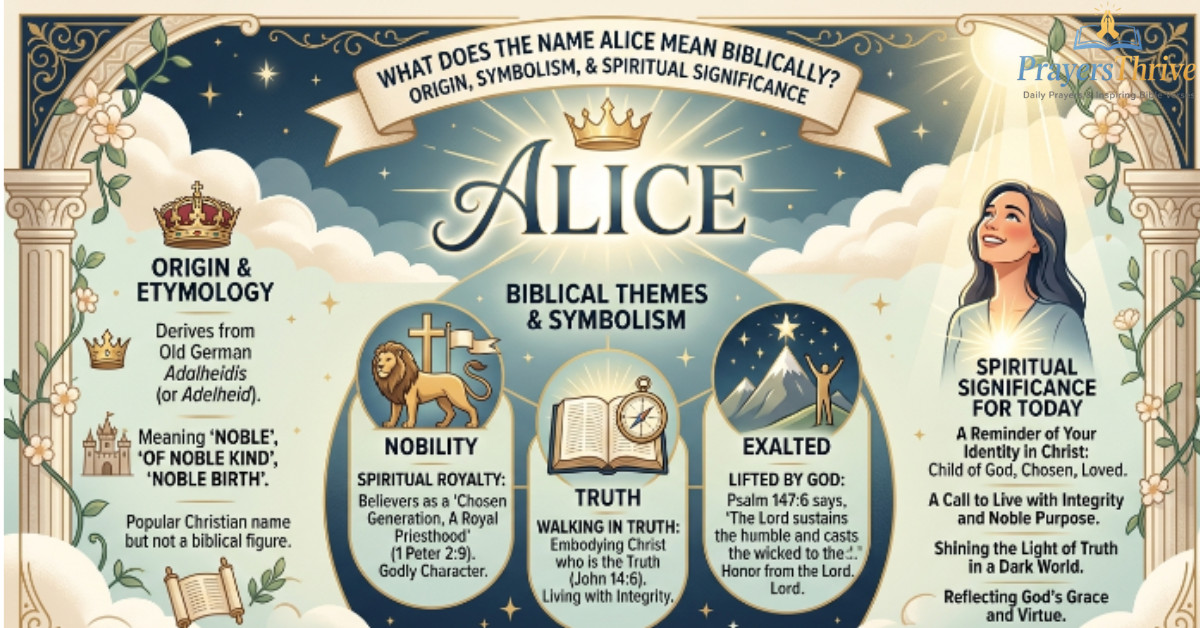
The name Alice carries a quiet elegance that has endured for centuries — but beneath its familiar sound lies a meaning that resonates deeply with biblical values and spiritual truth. While Alice does not appear by name anywhere in Scripture, the meaning behind it connects to themes that run throughout the entire Bible: nobility of character, inner strength, faithfulness to God, and a life lived with integrity and grace.
For anyone named Alice, or for a parent considering this name for a daughter, understanding its biblical and spiritual significance adds a layer of meaning that goes far beyond simple etymology. This is a name rooted in virtue, and virtue is something the Bible speaks about with great consistency and depth.
see also: 85 Bible Verses About Drinking Alcohol
The Origin and Etymology of the Name Alice
To understand the biblical meaning of the name Alice, it helps to trace where the name actually comes from. Alice is derived from the Old French name Aalis, which itself developed from the Old High Germanic name Adalheidis — a compound of two elements: adal, meaning “noble” or “nobility,” and heid, meaning “kind,” “sort,” or “type.” Together, the name carries the core meaning of “of noble kind” or “noble natured.”
The name traveled through medieval Europe, becoming particularly prominent in England following the Norman Conquest of 1066. It was embraced by queens, noblewomen, and commoners alike, and it has remained in consistent use across the English-speaking world ever since. Its longevity is a testament to the timelessness of what it represents — a quality of character rather than a marker of social position.
In a biblical context, this etymology is significant. The Bible rarely celebrates nobility of birth or status. What Scripture consistently honors is nobility of spirit — the kind of inner character that reflects God’s nature, pursues righteousness, and serves others with humility and love.
What the Bible Says About True Nobility
The concept of nobility in the Bible is almost entirely inward-facing. Unlike the world’s definition — which ties nobility to bloodlines, titles, and social standing — Scripture defines it through the condition of the heart and the quality of one’s relationship with God.
One of the clearest biblical pictures of noble character appears in Proverbs 31, where the “woman of noble character” (eshet chayil in Hebrew — literally “woman of valor”) is described in detail. She is industrious, wise, compassionate, fearless, and above all, God-fearing. The passage concludes with one of the most significant statements in the entire chapter: “Charm is deceptive, and beauty is fleeting; but a woman who fears the Lord is to be praised” (Proverbs 31:30). True nobility, in God’s eyes, is rooted in reverence — not reputation.
Acts 17:11 provides another dimension of biblical nobility. The Berean people are described as “more noble” than others because they received the Word of God with eagerness and then examined the Scriptures carefully to test what they heard. Their nobility was intellectual and spiritual — a hunger for truth and a commitment to seeking it diligently.
Philippians 4:8 offers what may be the clearest biblical definition of a noble mindset: “Finally, brothers and sisters, whatever is true, whatever is noble, whatever is right, whatever is pure, whatever is lovely, whatever is admirable — if anything is excellent or praiseworthy — think about such things.” The Greek word used here for “noble” is semnos, which carries the meaning of honorable, dignified, and worthy of respect. A person who orients their thoughts around these qualities lives out a truly noble existence in God’s sight.
These passages together paint a portrait that aligns beautifully with the meaning of the name Alice. A life described by this name, lived out in faith, would be one characterized by inner strength, wisdom, reverence, and a consistent pursuit of what is good and true.
Hebrew and Greek Roots That Connect to Alice’s Meaning
While Alice itself comes from Germanic roots, the values embedded in its meaning echo specific biblical concepts expressed in both Hebrew and Greek — the two primary languages of Scripture.
In Hebrew, the word adir (אַדִּיר) means “noble,” “majestic,” or “mighty,” and is used in the Old Testament to describe both God’s majesty and the dignity He calls His people to reflect. Psalm 16:3 refers to God’s people as “the noble ones in whom is all my delight” — a profound statement that connects nobility directly to belonging to God and living in alignment with His purposes.
In Greek, the New Testament word eugenēs (εὐγενής) means “noble-born” or “of noble character” and appears in Acts 17:11 in reference to the Bereans mentioned above. The word carries with it not just a social connotation but a moral and spiritual one — someone of eugenēs character is open-minded, discerning, and willing to pursue truth even when it challenges existing assumptions.
Together, these roots show that the concept of nobility woven into the name Alice has genuine biblical currency. It is not a borrowed or peripheral idea — it is central to how God describes the people He honors and the life He calls believers to live.
Alice as a Symbol of God’s Calling to His People
One of the most powerful dimensions of the biblical meaning of Alice is what it suggests about identity and calling. The Bible is clear that those who belong to God are called to live differently — not to reflect the values of the surrounding culture, but to embody something higher, something that points back to God’s own character.
1 Peter 2:9 declares: “But you are a chosen people, a royal priesthood, a holy nation, God’s special possession, that you may declare the praises of him who called you out of darkness into his wonderful light.” The language here is unmistakably noble — royal, chosen, holy, set apart. These are not descriptions of social status but of spiritual identity. Every believer, regardless of background or name, is called into this noble standing through faith in Christ.
For someone named Alice, this passage takes on personal resonance. The meaning of the name — noble, of noble kind — aligns with what God declares over His people. It is as though the name itself whispers a calling: to walk in the dignity of being God’s own, to reflect His character in every relationship and decision, and to live in a way that honors the identity He has given.
Ephesians 4:1 echoes this when Paul urges believers “to live a life worthy of the calling you have received.” A noble life, in biblical terms, is a worthy life — one that takes seriously the grace extended through Christ and responds with faithfulness, humility, and love.
Noble Character Traits Reflected in the Name Alice
When we explore the spiritual significance of Alice through a biblical lens, several character qualities emerge that connect both to the name’s meaning and to what Scripture consistently honors:
Integrity — The Bible repeatedly connects nobility to consistency of character. A noble person in Scripture is the same in private as they are in public, the same under pressure as they are in comfort. Proverbs 11:3 says “The integrity of the upright guides them.” For someone named Alice, integrity is embedded in the very definition of the name.
Humility — True biblical nobility is inseparable from humility. Jesus himself said, “Whoever wants to become great among you must be your servant” (Matthew 20:26). The noblest person in God’s kingdom is not the one who demands recognition, but the one who serves quietly, faithfully, and without seeking applause.
Wisdom — The Proverbs 31 woman is described as someone who “speaks with wisdom, and faithful instruction is on her tongue” (verse 26). Wisdom, in the Bible, is not simply intelligence — it is the practical application of God’s truth in everyday life. A name rooted in nobility carries an implicit call to pursue this kind of wisdom.
Courage — Biblical nobility is never passive. The women of faith celebrated in Scripture — from Deborah to Esther to Mary — demonstrated courage in circumstances that demanded it. The name Alice, carrying the energy of noble character, points toward a life willing to stand for what is right even when it is costly.
Compassion — The Proverbs 31 woman “opens her arms to the poor and extends her hands to the needy” (verse 20). Noble character in God’s kingdom is always outward-facing — concerned not just with personal virtue but with the wellbeing of others. A life that embodies the meaning of Alice reflects this kind of generous, attentive love.
see also: 12 Most Powerful Prayers in the Bible
Encouragement for Women and Girls Named Alice
If your name is Alice, Scripture has something meaningful to say to you — not because your name appears in the Bible, but because the values your name carries are woven throughout it.
You are named for nobility, and in God’s eyes, that nobility is not something you have to earn. It is something you are called into through your identity as someone created in His image and, for those who believe, redeemed through Christ. Galatians 4:7 declares that through faith, you are “no longer a slave, but God’s child; and since you are his child, God has made you also an heir.” There is no more noble identity than that.
The life your name points toward is one of character over comfort, integrity over image, and faithfulness over fame. It is a life that takes seriously the call to reflect God’s truth in the ordinary moments — in kindness shown to a stranger, in honesty chosen when dishonesty would be easier, in patience practiced when frustration would feel more natural.
Your name is a quiet reminder every time it is spoken: you are called to something noble. Not because of where you come from or what you have achieved, but because of whose you are and the kind of life that identity invites.
How the Name Alice Reflects God’s Design for Womanhood
The biblical portrait of a woman of noble character in Proverbs 31 is sometimes misread as a checklist or an impossible standard. But read in its full context, it is a celebration — a poem of praise for a woman whose nobility comes from the inside out. She is not noble because she never struggles or never fails. She is noble because her foundation is God, and from that foundation flows strength, wisdom, generosity, and love.
The name Alice, meaning “of noble kind,” reflects this same vision. It does not suggest a life free from difficulty, but a life that meets difficulty with the resources of faith. It does not promise perfection, but it points toward a quality of character that God both values and cultivates in those who walk with Him.
In this sense, Alice is more than a name — it is a description of the life God calls every woman of faith to pursue, regardless of what she is called.
FAQs
1. Does the name Alice appear anywhere in the Bible?
No, the name Alice does not appear directly in the Bible. However, its core meaning — “noble” or “of noble kind” — connects deeply to biblical themes of noble character, inner strength, and godly living found throughout both the Old and New Testaments.
2. What is the Hebrew equivalent or connection to the name Alice?
While there is no direct Hebrew equivalent of Alice, the Hebrew word adir (אַדִּיר), meaning “noble” or “majestic,” reflects the same core concept embedded in Alice’s Germanic root. The Bible uses this kind of language to describe both God’s majesty and the dignity He calls His people to reflect in their lives.
3. What biblical figures best represent the qualities of the name Alice?
The woman described in Proverbs 31 is perhaps the clearest biblical parallel — noble, wise, compassionate, courageous, and God-fearing. Figures like Esther, who showed courage and integrity under pressure, and Ruth, who demonstrated faithfulness and loyal love, also embody the character qualities that the meaning of Alice reflects.
4. How can someone named Alice live out the biblical meaning of their name?
By pursuing the qualities Scripture associates with noble character — integrity in private and public life, humility in relationships, wisdom in decisions, compassion toward others, and a consistent, genuine faith in God. The biblical meaning of Alice is not a passive description but an active calling — an invitation to live in a way that reflects God’s truth and honors the identity He has given.
Conclusion
The biblical meaning of the name Alice reaches further than its Germanic roots and medieval history. It touches something timeless — the call to live a life of noble character, rooted in faith, expressed through integrity, and sustained by a genuine relationship with God.
Alice is a name that carries weight. It speaks of a woman created with dignity, called with purpose, and equipped by grace to reflect something of God’s own character in the world. While the name itself is not found in Scripture, the values it embodies are present on almost every page — in the wisdom of Proverbs, the courage of Esther, the faithfulness of Ruth, and the radical redefinition of greatness that Jesus himself modeled and taught.
For anyone who carries this name — or is considering giving it — the spiritual significance of Alice is a gift worth understanding. It is a reminder that true nobility has never been about titles or status, but about the condition of the heart and the direction of a life. And that kind of nobility, built on faith and shaped by God’s word, is something that endures far beyond any earthly measure.

I’m Aria, an AI content writing expert with 3 years of experience, creating engaging and inspiring faith-based content for readers seeking prayers, blessings, and Bible insights.