
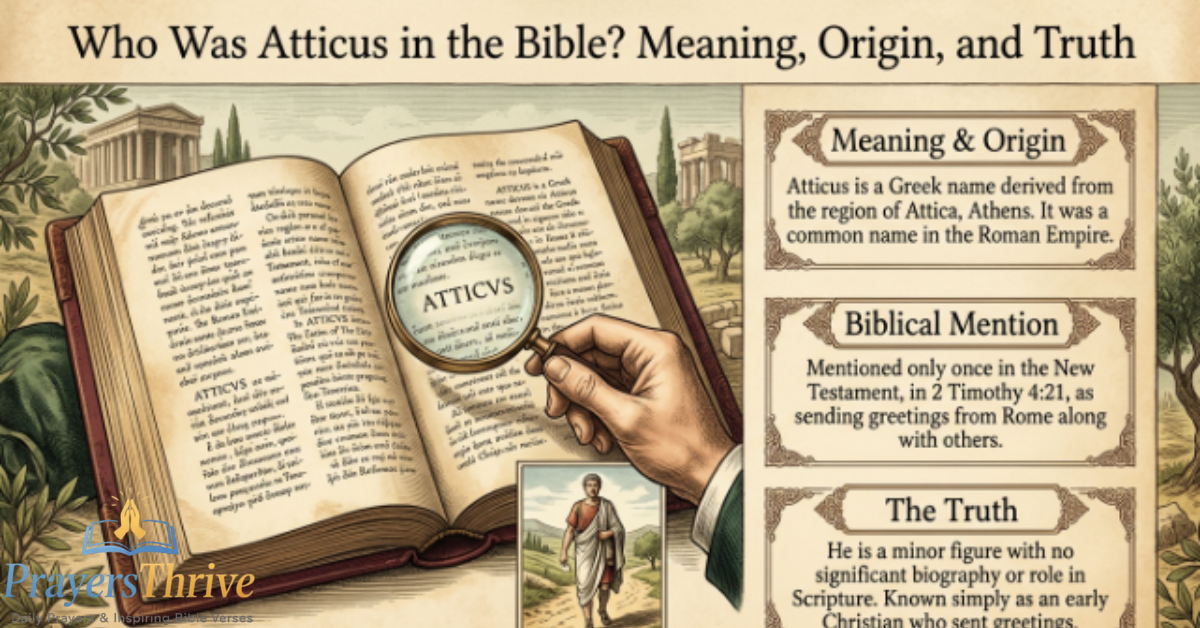

The name Atticus has a certain old-world elegance that makes people pause and wonder where it came from, and for many curious readers the first place their mind jumps to is Scripture. It is easy to see why: the name sounds ancient, dignified, and almost priestly, the kind of name you would expect to find tucked inside a genealogy or a letter from an apostle. Yet a careful reading of the Old and New Testaments tells a different story.
This guide walks through the real linguistic roots of Atticus, the historical figures who actually carried the name, and the reason it keeps getting associated with the Bible even though it never appears there. Along the way, we will separate the literary character Atticus Finch from the actual church history behind the name, and we will look at how Attic Greek culture shaped early Christianity without ever making its way into the biblical text. By the end, you will know exactly where the name belongs historically, what it means linguistically, and why so many people still search for it in Scripture.
see also: 100+ Heartfelt Goodnight Prayers for Him in a Long Distance Relationship
Does the Bible Mention Atticus?

The short and direct answer is no. Atticus does not show up in the Hebrew Scriptures, the Greek New Testament, or any of the widely recognized biblical manuscripts, translations, or textual variants scholars have catalogued over the centuries. There is no tribe, prophet, disciple, king, or minor character carrying this name in the sixty-six books that make up the Protestant canon, nor does it surface in the Catholic or Orthodox deuterocanonical additions.
That said, the absence of a name from Scripture does not mean the name lacks a history within Christianity. Names such as Atticus circulated widely across the Greek-speaking and Roman-influenced world in which the early church took shape, and some of those names eventually attached themselves to real people who shaped Christian history long after the New Testament was completed. Understanding that distinction, a name being culturally adjacent to Christianity versus a name being written into Scripture itself, is the key to answering this question correctly.
Where the Name Actually Surfaces
Because the name never appears in canonical Scripture, its recorded history lives instead in secondary Christian and classical sources. A few notable places include:
- Ecclesiastical histories written by Socrates Scholasticus and Sozomen, which document church leadership in the fifth century
- Greco-Roman literature and inscriptions describing wealthy citizens, teachers, and officials of Athens and the surrounding Attica region
- Later monastic letters and regional church records that mention clergy or civic figures by this name
None of these sources qualify as Scripture, but they explain why the name feels historically Christian-adjacent even though it is biblically absent.
The True Meaning and Linguistic Origin of Atticus
Atticus is not a Hebrew or Aramaic name, which immediately sets it apart from most names found in the Bible. Instead, it descends from Greek and Latin roots tied to a specific geographic region: Attica, the peninsula surrounding the city-state of Athens. In antiquity, Attica was synonymous with philosophy, rhetoric, drama, and refined learning, so a name derived from it inherited those associations almost automatically.
In Latin, Atticus functions as an adjective-turned-name meaning “of Attica” or “belonging to Attica.” Roman writers used it as both a personal name and a descriptive title for someone connected to Athenian culture, education, or citizenship. In Greek, the underlying word is Ἀττικός (Attikós), which likewise translates to “Athenian” or “native of Attica.” Because Athens held such prestige as an intellectual center, the name picked up secondary connotations of eloquence, wisdom, and cultivated taste that had nothing to do with religion at all.
| Language | Original Word | Literal Meaning | Cultural Association |
| Latin | Atticus | Of Attica / belonging to Attica | Refinement, Roman aristocracy |
| Greek | Ἀττικός (Attikós) | Athenian / native of Attica | Philosophy, rhetoric, learning |
| Modern English | Atticus | Man of Athens | Wisdom, integrity, classical elegance |
| Symbolic Usage | Atticus | Scholarly, principled character | Popularized by 20th-century literature |
This table makes the pattern clear: every layer of meaning traces back to geography and culture, never to a Hebrew root word or a theological concept, which is a strong indicator that the name was never meant to carry biblical weight in the first place.
Atticus vs. Atticus Finch: Untangling the Connection
A large share of modern interest in this name comes not from church history but from literature. Harper Lee’s 1960 novel introduced readers to Atticus Finch, a small-town Alabama lawyer whose quiet courage and moral clarity made him one of the most admired fictional characters of the twentieth century. Because Finch is often described using words like righteous, wise, and just, readers sometimes assume his name must trace back to Scripture.
It does not. Lee drew on the classical meaning of the name, choosing a word associated with Athenian wisdom and dignity to match the character she wanted to portray. There is no evidence that she intended any biblical reference at all. The overlap people sense is thematic rather than textual: Atticus Finch embodies virtues that Scripture also praises, such as fairness, humility, and steadfastness, but the name itself was borrowed from classical antiquity, not from any Bible passage.
Why the Confusion Persists
Several factors keep this misunderstanding alive:
- The novel is required reading in many religious and moral education settings, which primes readers to look for scriptural parallels
- Atticus Finch is frequently held up as a model of Christian-style virtue in sermons and character studies, even though the connection is thematic rather than literal
- The name’s ancient sound makes it feel automatically biblical to readers unfamiliar with Greek and Latin naming conventions
Recognizing these factors helps explain why so many people type “Atticus Bible” into a search engine without ever finding a scriptural answer.
Atticus of Constantinople: The Historical Church Figure
While the name is absent from Scripture, it does belong to real church history through Atticus of Constantinople, who served as archbishop of Constantinople in the early fifth century. He is remembered in ecclesiastical writings for his role in doctrinal disputes following the controversial removal of John Chrysostom, as well as for pastoral reforms carried out during his tenure.
Atticus is documented primarily through the historical works of Socrates Scholasticus and Sozomen, both of whom wrote detailed continuations of church history covering this period. These accounts describe him as a capable administrator who worked to stabilize the Eastern Church during a turbulent stretch of controversy and political pressure from imperial authorities.
| Detail | Description |
| Full Historical Role | Archbishop of Constantinople |
| Approximate Tenure | Early fifth century, following the removal of John Chrysostom |
| Primary Historical Sources | Socrates Scholasticus, Sozomen |
| Known For | Doctrinal mediation, pastoral reform, church stabilization |
| Biblical Status | Not mentioned in Scripture; documented only in post-biblical church history |
This table underlines an important nuance: Atticus of Constantinople is a legitimate figure in Christian history, but “Christian history” and “biblical text” are not interchangeable categories. His story belongs to the centuries after the New Testament canon closed.
Why the Name Atticus Is Often Linked to Scripture
Several overlapping reasons explain why people keep searching for a biblical connection that does not exist.
First, the name has an archaic, dignified sound that resembles other classical or Hebrew-Greek hybrid names found in the New Testament, such as Tertius, Lucius, or Fortunatus, all of which were common in the Greco-Roman world the apostles moved through. Because those names do appear in Scripture, readers sometimes assume every ancient-sounding name from that era must appear as well.
Second, the popularity of Atticus Finch has created a cultural association between the name and moral, almost sermon-like virtue, which primes people to expect a scriptural origin.
Third, general curiosity about biblical baby names has surged in recent years, and search engines frequently surface unrelated or loosely related names alongside genuine biblical ones, blurring the line between “sounds biblical” and “is biblical.”
Finally, Atticus of Constantinople’s genuine role in early church history gives the name a layer of Christian legitimacy that, while historically accurate, does not extend backward into the biblical text itself.
Comparing Atticus to Other Names Mistaken for Biblical Ones
Atticus is far from the only name that gets mistakenly assumed to be biblical. A quick comparison shows how this pattern repeats across many names with strong cultural, literary, or historical associations.
| Name | Actual Origin | Commonly Mistaken As | Reality |
| Atticus | Greek/Latin, region of Attica | A biblical figure or virtue name | Not in Scripture; tied to church history and literature |
| Sage | English word for wisdom | A biblical wisdom name | Not found in the Bible in this form |
| Serenity | Latin-derived English word | A biblical virtue name | Absent from canonical Scripture |
| Nova | Latin for “new” | A prophetic or celestial biblical name | Not a biblical term or name |
Seeing Atticus alongside these examples makes the broader pattern easier to understand: names that sound spiritually weighty or classically elegant are frequently assumed to be biblical purely because of tone, not because of any documented textual presence.
The Cultural and Historical Weight of the Name Atticus
Even without a scriptural foothold, Atticus carries genuine historical substance. In the Greco-Roman world, the name was associated with education, civic standing, and philosophical refinement. Herodes Atticus, a wealthy Athenian teacher and benefactor from the second century, is one of the more famous bearers of the name in classical literature, remembered for funding public works and mentoring students across the Roman Empire.
That same cultural backdrop shaped the world the early church operated within. The apostle Paul preached in Athens itself, engaging directly with Greek philosophers on Mars Hill, and the broader Attic intellectual tradition influenced how early Christian writers framed theological arguments for a Hellenistic audience. So while the name Atticus never entered the biblical text, the region and culture it represents left a real mark on how Christianity communicated with the ancient world.
Hidden and Rare Names Within the Bible
For readers who came looking for biblical names and found none under “Atticus,” it is worth pointing toward the genuinely rare and often-overlooked names that do appear in Scripture. These figures rarely receive attention because they surface briefly, sometimes in a single verse, yet each carries a story worth knowing.
- Jael, remembered for a decisive act of courage during a period of conflict in the book of Judges
- Ahithophel, a trusted royal advisor whose counsel later turned against King David
- Jabez, known for a short but memorable prayer recorded in Chronicles
- Shiphrah and Puah, two midwives credited with quiet defiance during the Exodus narrative
- Onesiphorus, mentioned briefly in Paul’s letters for his loyalty and support
- Barzillai, an elderly supporter of David during a difficult period of exile
These names demonstrate the genuine diversity of biblical characters, standing in contrast to names like Atticus that, despite their classical dignity, simply never made it into the text.
Should Christian Parents Consider Naming a Child Atticus?
Plenty of parents choose names for their sound, symbolism, or literary resonance rather than strict biblical presence, and Atticus fits comfortably into that category. Its meaning, rooted in Athenian culture and intellectual heritage, pairs naturally with qualities like wisdom, integrity, and quiet strength, especially given its association with Atticus Finch’s steady moral character.
| Consideration | Detail |
| Biblical Presence | None; the name does not appear in Scripture |
| Symbolic Meaning | Wisdom, integrity, Athenian intellectual heritage |
| Literary Association | Atticus Finch, admired for fairness and moral courage |
| Historical Christian Tie | Atticus of Constantinople, a real archbishop, though post-biblical |
| Suitability for Christian Families | Widely considered acceptable due to strong virtue associations, even without scriptural roots |
Choosing a name for its symbolic weight rather than its scriptural pedigree is common practice, and many parents find that Atticus offers a rare combination of classical depth and modern literary respect.
The Historical Timeline of the Name Atticus Through the Centuries
Tracing the name across different eras shows how far it has traveled from its geographic roots to its modern literary fame. In classical antiquity, it functioned mainly as a descriptive title for Athenian citizens and scholars. By the Roman period, it had become a genuine personal name carried by philosophers, teachers, and wealthy patrons. Centuries later, it resurfaced within church administration through Atticus of Constantinople, before eventually fading from common use for a long stretch of history. Its most recent revival owes almost everything to twentieth-century American literature, which reintroduced the name to a global audience under an entirely new cultural lens.
| Era | Primary Context | Notable Association |
| Classical Antiquity | Athenian civic identity | Descriptive regional title |
| Roman Period | Personal name among elites | Herodes Atticus, philosophers and teachers |
| Early Christian Era | Church leadership | Atticus of Constantinople |
| Modern Era | Literature and naming trends | Atticus Finch, contemporary baby names |
This progression makes clear that the name’s journey has been shaped by geography, then by religion, and finally by fiction, rather than by any single unbroken tradition.
How Attic Greek Culture Shaped the New Testament World
Long before the name Atticus became attached to any individual, the region of Attica and its dialect, Attic Greek, played an outsized role in shaping the intellectual environment of the ancient Mediterranean. Attic Greek eventually gave way to Koine Greek, the common dialect in which the entire New Testament was written, so while the name itself never entered Scripture, the linguistic lineage behind it is deeply intertwined with the language the apostles used.
Paul’s engagement with Greek philosophers in Athens, recorded in the book of Acts, illustrates just how present this culture was in the daily life of early believers. Stoic and Epicurean thinkers, many shaped by the Attic intellectual tradition, formed part of Paul’s audience, and his rhetorical style at times reflects the persuasive techniques common to Athenian oratory. In this sense, the world that produced the name Atticus is the same world the gospel spread through, even though the word itself never made it onto the page.
Common Misspellings and Search Variations for the Name Atticus
People searching for information on this topic often type the name in slightly altered forms, which can lead to confusing or irrelevant results. Recognizing these variations helps clarify that none of them carry any additional biblical meaning either.
- Attikus, an anglicized misspelling with no separate origin
- Atticous or Atticuss, phonetic variations with no linguistic basis
- Aticus, a shortened spelling that still traces back to the same Greek and Latin root
- Attica (as a first name), sometimes confused with the masculine form Atticus
Regardless of spelling, every variation traces back to the same Attic Greek and Latin origin, and none of them appear in biblical manuscripts under any form.
Atticus in Modern Baby Name Trends and Popularity
Interest in the name has grown steadily over the past two decades, largely driven by renewed appreciation for classic literature and a broader cultural shift toward vintage, meaning-rich names. Parenting publications and naming databases consistently list Atticus among rising choices for boys, often grouped alongside other literary or classical names that carry a similar dignified tone.
Part of this popularity stems from parents wanting a name that feels timeless without being overused, and Atticus fits that criterion well since it remains distinctive while still being easy to pronounce and spell. Its rise in modern naming charts has nothing to do with religious usage and everything to do with cultural nostalgia for literature that emphasizes strong moral character.
Numerology and Symbolic Interpretation of Atticus
Outside of strict linguistic history, some parents and naming enthusiasts look at symbolic or numerological interpretations of names before choosing one for a child. While these interpretations carry no biblical or scholarly authority, they are worth understanding since they often circulate alongside naming discussions.
In popular numerology systems, the name Atticus is frequently associated with leadership, independence, and analytical thinking, traits that loosely echo the intellectual reputation of ancient Athens. These interpretations are cultural rather than religious, and they should be understood as folklore rather than doctrine, especially since nothing comparable exists within biblical tradition for names outside of Scripture.
Famous People Named Atticus Beyond History and Literature
Beyond Atticus of Constantinople and the fictional Atticus Finch, the name has been carried by a range of real individuals across different centuries and fields, further reinforcing its non-biblical, culturally diverse background.
| Name Bearer | Field or Era | Relevance |
| Herodes Atticus | Second-century Athens | Wealthy philosopher, teacher, and civic benefactor |
| Atticus of Constantinople | Fifth-century church history | Archbishop and doctrinal mediator |
| Titus Pomponius Atticus | Roman Republic | Close friend and correspondent of Cicero |
| Modern namesakes | Contemporary usage | Musicians, authors, and public figures adopting the name |
Titus Pomponius Atticus in particular is worth noting, since his extensive correspondence with the Roman statesman Cicero is one of the best-documented uses of the name in classical literature, long before any Christian association existed.
How Bible Translators Handle Similar-Sounding Greek Names
Because Atticus resembles other Greek-origin names that do appear in the New Testament, it is worth understanding how biblical translators generally approach such names. Names like Epaphroditus, Aristarchus, and Sopater appear throughout Paul’s letters and the book of Acts, reflecting the same Greek naming conventions that produced Atticus, yet each of these names is documented through direct manuscript evidence, unlike Atticus itself.
Translators rely strictly on the earliest available Greek manuscripts when deciding which names belong in Scripture, meaning no amount of cultural popularity or historical plausibility can insert a name into the biblical text retroactively. This is precisely why Atticus, despite fitting the same linguistic pattern as several New Testament figures, has never been included in any translation, ancient or modern.
Atticus and the Broader Tradition of Virtue-Based Naming
Many cultures, including early Christian communities, have long favored names that symbolize desirable character traits rather than names drawn strictly from religious texts. Atticus fits neatly into this broader tradition, standing alongside names chosen for their meaning rather than their scriptural pedigree.
This naming philosophy explains why a name like Atticus can feel spiritually resonant to modern parents even without biblical origin. Its association with wisdom, fairness, and intellectual dignity mirrors virtues Scripture consistently praises, even though the word itself belongs to Athens rather than to any biblical author.
What Archaeology Reveals About the Attica Region
Archaeological excavations throughout Attica, particularly around Athens, have uncovered extensive evidence of the region’s role as a hub of philosophy, governance, and education during antiquity. Sites such as the Athenian Agora and the Acropolis reveal a society deeply invested in rhetoric, civic debate, and structured learning, the same qualities later reflected in the symbolic meaning attached to the name Atticus.
This archaeological backdrop reinforces why the name never needed a biblical connection to carry weight. Its prestige came directly from the tangible cultural achievements of the region it describes, achievements that were already well established centuries before Christianity emerged as a distinct faith tradition.
Frequently Confused Names: Atticus, Atlas, and Augustus Compared
Because of overlapping sounds and classical origins, Atticus is sometimes mentally grouped with other ancient-sounding names such as Atlas and Augustus. Comparing them side by side clarifies that each has an entirely separate origin and meaning.
| Name | Origin | Core Meaning | Biblical Presence |
| Atticus | Greek/Latin, Attica region | Man of Athens | None |
| Atlas | Greek mythology | Titan who bore the weight of the sky | None |
| Augustus | Latin | Venerable, majestic, imperial title | None, though the term appears descriptively in some translations referencing Roman rulers |
Even Augustus, which occasionally surfaces in discussions of Roman-era Scripture due to references to Caesar Augustus in the Gospel of Luke, is a title rather than a name shared with Atticus in origin. This comparison shows that surface-level similarity between ancient names rarely indicates any shared biblical status.
Conclusion
Atticus carries an undeniable air of ancient dignity, but that dignity comes from Athens and Rome, not from the pages of Scripture. Its Greek and Latin roots point toward intellectual heritage and cultural refinement rather than any biblical narrative or theological meaning.
The name’s closest brush with Christianity comes through Atticus of Constantinople, a real historical archbishop who lived centuries after the New Testament was completed. Meanwhile, its modern popularity owes far more to Atticus Finch and the enduring legacy of American literature than to any verse of Scripture.
Recognizing this distinction allows the name to be appreciated honestly, for its classical elegance and literary weight rather than a biblical status it never actually held. For readers drawn to genuinely biblical names, exploring the Bible’s own rare and overlooked figures offers a far richer and more accurate alternative. Atticus remains a beautiful name with a real history, just not the one many people originally expect to find.
see also: 75 Heartfelt Good Night Prayers for the One You Love
FAQs
Does the name Atticus appear anywhere in the Bible?
No, it is absent from every canonical book of the Old and New Testaments.
What does Atticus actually mean?
It means “man of Attica” or “Athenian,” derived from Greek and Latin roots tied to the region around Athens.
Is Atticus Finch connected to a biblical figure?
No, Harper Lee based the name on its classical Athenian meaning, not on Scripture.
Was there ever a real Christian figure named Atticus?
Yes, Atticus of Constantinople served as a fifth-century archbishop, though he lived long after the biblical era ended.
Why do so many people assume Atticus is a biblical name?
Its dignified, ancient sound and its association with virtuous literary and historical figures create that impression, even though no textual evidence supports it.
Is it appropriate for Christian parents to choose this name?
Many consider it appropriate because of its strong meaning and virtuous associations, even though it has no direct scriptural origin.

I’m Aria, an AI content writing expert with 3 years of experience, creating engaging and inspiring faith-based content for readers seeking prayers, blessings, and Bible insights.