
Close your eyes and picture God, and chances are an image appears almost automatically: an elderly man with a flowing white beard, seated somewhere above the clouds. That picture feels ancient and familiar, yet it comes almost entirely from Renaissance painters and centuries of religious art rather than from the Bible itself. Scripture takes a very different approach to this question, one that is stranger, more symbolic and ultimately more meaningful than any single portrait could ever be.
This guide walks through what the Bible actually says when prophets describe encountering God’s glory, why scripture insists He cannot be reduced to a physical form at all, how Jesus factors into this question in a way nothing else does, and where the familiar cultural image came from if not from the biblical text. Along the way, it also unpacks the attributes scripture emphasizes instead of appearance, since understanding who God is turns out to matter far more than picturing what He looks like.
see also: Jayden Name Meaning: Biblical Origin, Spiritual Significance & Symbolism
Why This Question Reveals More About Culture Than About Scripture
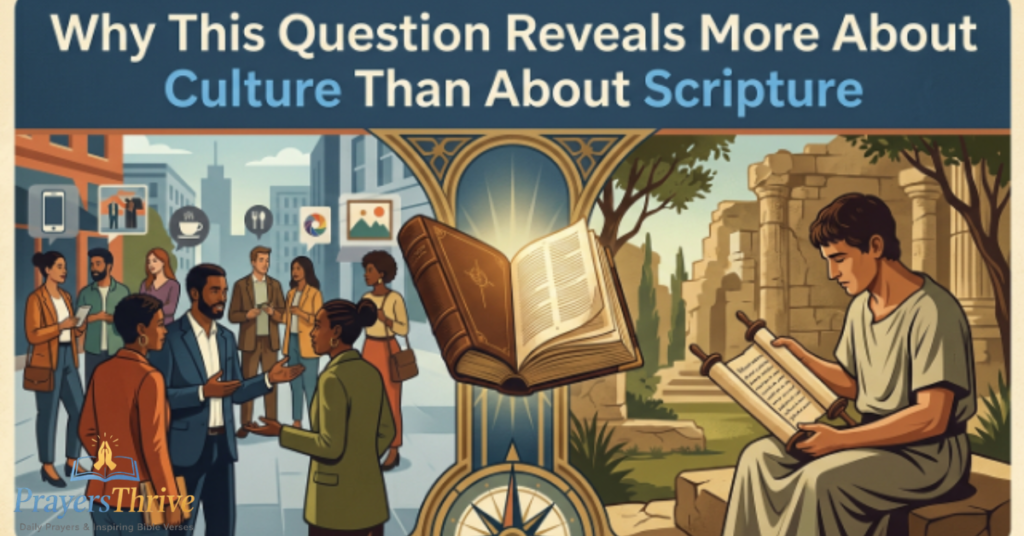
Asking what God looks like assumes He can be captured visually the way a person or an object can, and that assumption itself says something important before any answer is even given. Every culture throughout history has been tempted to shrink the divine down into something manageable, something that can be pictured, painted or placed on a shelf. Scripture consistently resists that temptation, insisting on a being who exceeds visual description rather than one who simply hasn’t been drawn correctly yet.
Recognizing this upfront reframes the entire question. Rather than searching for the missing detail that would finally let us sketch an accurate portrait, the biblical text invites something closer to wonder, an acknowledgment that the answer may never arrive in the form we expect, and that this is itself part of the point.
The Starting Point Scripture Gives Before Any Description of Appearance

What It Means That God Is Spirit Rather Than a Physical Being
Before any prophet’s vision or any poetic description, scripture establishes a foundational claim that shapes everything that follows: God is spirit. This single statement, spoken plainly by Jesus in conversation with a woman at a well, rules out the idea of a fixed physical body from the outset. A being who is spirit is not confined to one location, one shape or one set of physical features the way a human being is.
This matters enormously for how the rest of scripture’s imagery should be read. Every later description of thrones, robes, fire and light functions as accommodation, a way of communicating something true about an infinite being using language and imagery that finite human minds can process, rather than a literal photograph of divine anatomy.
Why Ancient Israel Was Forbidden From Making Any Image of Him
This spiritual nature is precisely why the ancient Israelites received such a strict prohibition against crafting any physical representation of God, whether carved from wood, cast in metal or painted on a wall. The concern was not simply about idolatry in the narrow sense of worshiping the wrong deity. It was about the deeper danger of reducing an infinite being to something small enough to control, predict and manage.
Any image, however reverent the intention behind it, inevitably imposes human limitations onto a being who has none. This commandment reveals something important about the entire biblical approach to this topic: scripture consistently protects mystery rather than resolving it into something comfortably familiar.
The Prophetic Visions Where Glory Comes Closest to a Description

Ezekiel’s Vision of a Throne Wrapped in Fire and Light
Among the most striking passages addressing this topic is Ezekiel’s vision of a throne, described in layered, almost hesitant language. The prophet describes something resembling a human figure, surrounded by brightness comparable to fire from the waist down and glowing metal from the waist up, encircled by a radiance like a rainbow after rain. Even here, Ezekiel is careful to describe an appearance of a likeness rather than claiming a direct, literal description, a linguistic caution that runs throughout the passage.
That careful, layered phrasing is not accidental. It reflects a prophet reaching for the outer edges of human language to describe something that language was never fully equipped to contain.
Isaiah’s Vision of a Robe That Filled the Temple
Isaiah’s temple vision offers a similarly overwhelming picture, describing a throne so elevated and a robe so vast that its train alone filled the entire sanctuary. Heavenly beings surrounding the throne cover their own faces while declaring His holiness, and the entire structure of the temple shakes at the sound of their voices. Isaiah’s own response is not curiosity or admiration but immediate terror, a conviction that he is undone simply by proximity to what he has witnessed.
This reaction says as much about the nature of the vision as the vision itself does. An encounter this overwhelming cannot be casually observed or calmly sketched; it demands an emotional and spiritual response that goes far beyond visual description.
John’s Vision of a Radiant Figure in Revelation
In the New Testament, John’s vision on the island of Patmos describes a glorified figure with hair as white as wool, eyes described as blazing fire and a face compared to the sun shining at full strength. Even this description, arguably the most detailed physical language found anywhere in scripture, relies almost entirely on comparison rather than direct depiction, reaching for the most intense natural images available to convey something that exceeds ordinary sight.
Why These Visions Use Symbol Rather Than Literal Detail
Taken together, these three visions share a common pattern worth noticing. Each one reaches for comparison rather than direct statement, using words like “appearance,” “likeness” and “as” rather than flatly declaring what was seen. This pattern is not a failure of description. It is a deliberate literary and theological choice, communicating that whatever these prophets encountered exceeded ordinary categories of sight and could only be approached through metaphor.
The Many Forms Through Which God Chose to Be Encountered
A Flame That Burned Without Consuming Anything
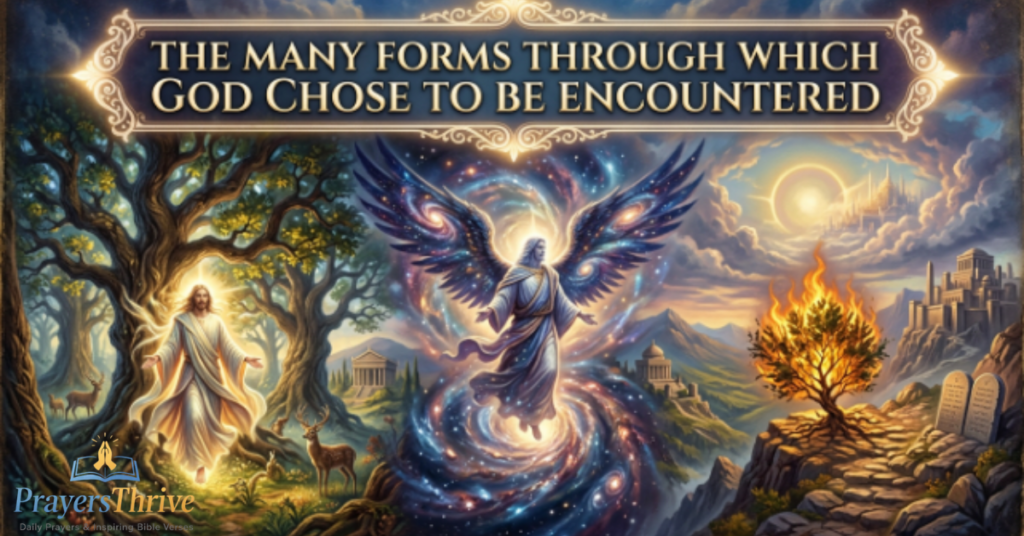
Long before these prophetic visions, scripture records an encounter involving a shepherd and a bush that burned steadily without ever being consumed by the flame. This image captured something essential about the nature being encountered: an intensity and holiness that could coexist intimately with ordinary creation without destroying it, a paradox that set the tone for many later encounters throughout scripture.
A Cloud and Fire That Led an Entire Nation
During a long wilderness journey, an entire community was guided not by a visible figure but by a cloud during daylight hours and a pillar of fire through the night. This form of presence emphasized guidance and protection over physical appearance, communicating direction and nearness through something that could be followed but never fully grasped or contained.
A Whisper Heard by a Broken Prophet
In a striking contrast to fire, wind and earthquake, one prophet in a moment of exhaustion and despair encountered God not through dramatic spectacle but through what scripture describes as a low, quiet whisper. This encounter suggests that overwhelming visual glory is not the only, or even the primary, way this presence chooses to be known, particularly in moments of personal vulnerability.
A Glory That Filled a Physical Tent of Worship
When a portable place of worship was completed in the wilderness, scripture describes a cloud filling the structure so completely that even the appointed leader could not enter, and a visible glory settling over it that the entire community could observe from a distance. This filling of physical space demonstrated a form of presence tied to worship and covenant rather than to any singular visual form.
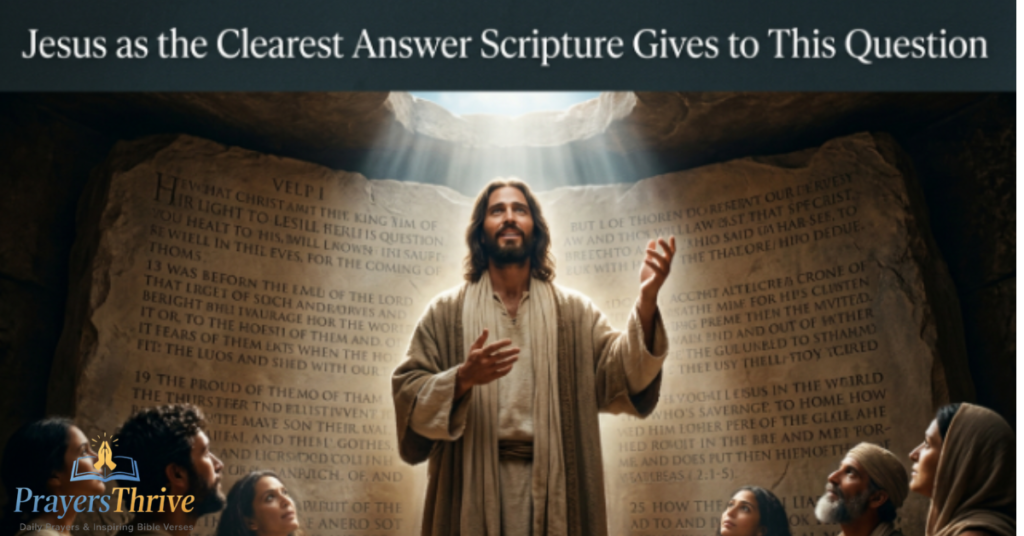
Jesus as the Clearest Answer Scripture Gives to This Question
What It Means That He Is Called the Exact Representation of God
If any single answer to this question exists within scripture, it centers on Jesus rather than on any vision, cloud or flame. The New Testament describes him using language of exact representation and perfect image, terms drawn from the practice of a seal pressed into wax, leaving behind an unmistakable, precise impression. This is not devotional exaggeration. It is presented as the central theological claim of the entire New Testament.
Where earlier visions offered glimpses through smoke, fire and symbol, this claim suggests something categorically different: a complete, walking, speaking representation of divine character expressed within human history and human form.
How His Actions on Earth Displayed the Character Behind the Glory
Beyond physical description entirely, the Gospels record a pattern of actions that scripture presents as direct displays of divine character. Compassion toward the sick, confrontation of exploitative religious practice, grief at human loss and sacrifice on behalf of others are all framed not merely as admirable human behavior but as direct windows into the nature of God himself. In this sense, the clearest answer to what God looks like may have less to do with visual appearance and everything to do with the pattern of a life fully lived out in human history.
Why Every Prophet Reacted With Fear Rather Than Curiosity
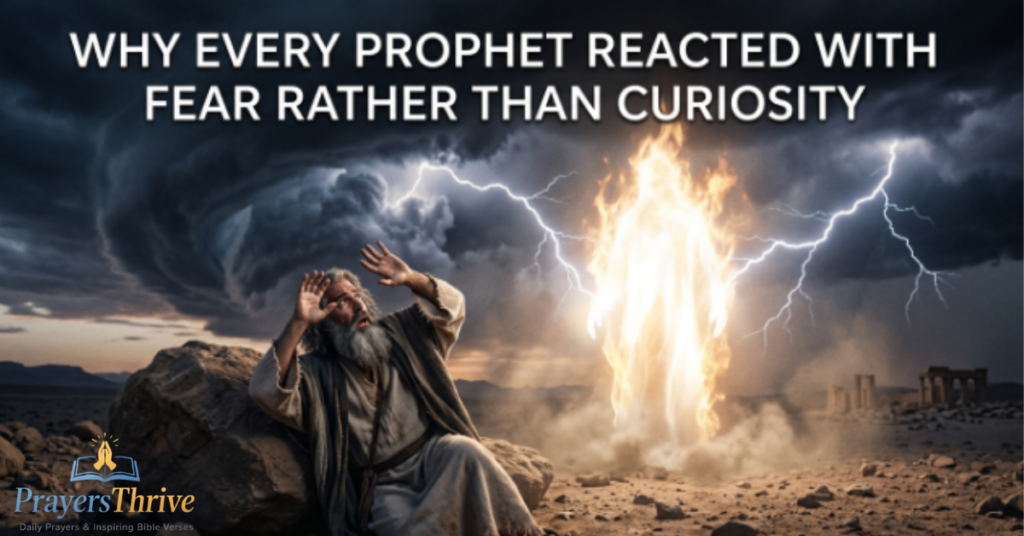
A detail easy to overlook across these accounts is the consistent emotional response of those who encountered this glory. Rather than fascination or calm observation, the recorded reaction is almost always fear, a sense of being fundamentally undone by proximity to something far greater than the observer. This pattern suggests that whatever these encounters actually involved, they carried a weight and intensity that ordinary human experience rarely produces, further reinforcing why a simple visual description was never really the point of these passages.
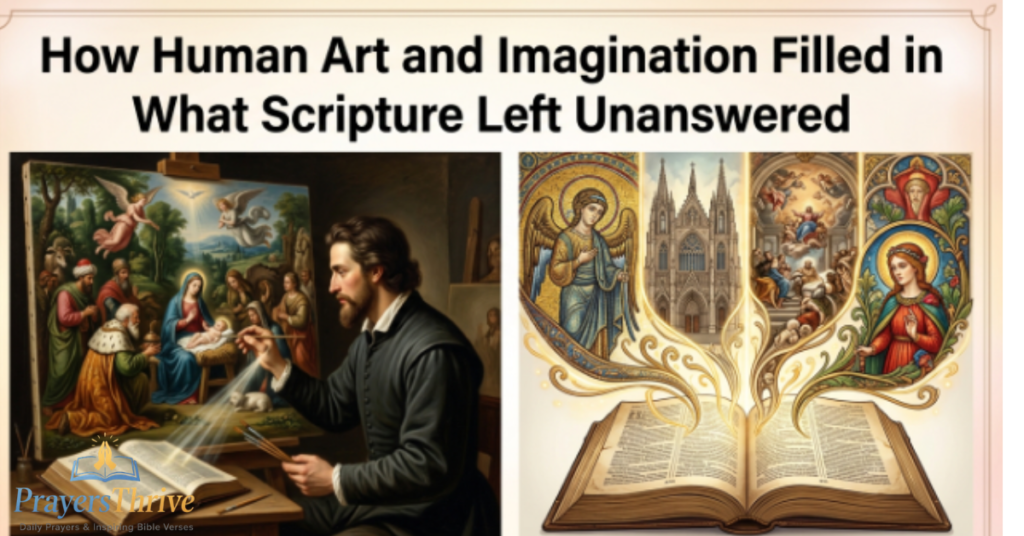
How Human Art and Imagination Filled in What Scripture Left Unanswered
The Bearded Elder in the Clouds and Where That Image Came From
Given how little scripture offers by way of direct physical description, it may seem surprising how confidently most people can picture God today. That confident mental image traces back largely to centuries of religious painting, particularly Renaissance-era artwork that needed a visual shorthand for an abstract theological concept audiences could immediately recognize. An elderly, authoritative, fatherly figure became the practical solution, regardless of how loosely it connected to the biblical text itself.
Why This Popular Image Says More About Us Than About Him
Over generations, this artistic convention hardened into something many people now assume is simply how the Bible describes God, when in reality it reflects an artistic decision made centuries after scripture was written. Recognizing this history matters because it reveals how easily a culturally convenient image can quietly replace the more complex, symbolic and ultimately more accurate biblical picture, without most people ever noticing the substitution taking place.
The Attributes Scripture Emphasizes Instead of a Physical Form
A Power With No Limit
Rather than lingering on appearance, scripture returns again and again to a set of attributes that define who God is far more thoroughly than any visual description could. Among the most repeated is limitless power, a capability described as encountering no obstacle it cannot overcome and no purpose it cannot ultimately accomplish.
A Knowledge That Misses Nothing
Alongside this power sits a knowledge described as complete, extending to the end of every matter from its very beginning, leaving nothing hidden, forgotten or overlooked.
A Presence Found in Every Place at Once
Scripture also describes a presence not confined to any single location, capable of being encountered in the highest heights and the lowest depths simultaneously, a quality that offers particular comfort to anyone who has ever felt isolated or unseen.
A Holiness Set Apart From Anything Corrupt
Perhaps the most frequently emphasized attribute across scripture is holiness, a complete separation from anything false, corrupt or evil. This attribute functions as the foundation for trustworthiness itself, since a being capable of compromise or corruption could never be fully relied upon.
A Justice That Never Bends
Flowing directly from holiness, scripture describes a justice that responds consistently and rightly to wrongdoing, refusing to overlook evil regardless of circumstance or status.
A Mercy Extended to the Undeserving
Alongside this unbending justice, scripture describes a mercy that extends compassion specifically toward those who have not earned or deserved it, a quality frequently paired with justice rather than positioned as its opposite.
A Faithfulness That Never Breaks a Promise
Scripture repeatedly emphasizes reliability, describing a being who keeps every commitment made, regardless of how long fulfillment takes or how difficult circumstances become along the way.
A Character That Never Shifts Across Time
Finally, scripture describes an unchanging nature, consistent from the earliest chapters of Genesis through the closing chapters of Revelation, a stability that stands in sharp contrast to the constantly shifting nature of human character and circumstance.
Understanding the Trinity Without Reducing God to One Simple Picture
Three Persons Present in a Single Divine Being
Adding further complexity to any attempt at a single physical description, scripture describes God existing as three distinct persons within a single divine being, traditionally identified as Father, Son and Holy Spirit. This structure appears at pivotal moments throughout scripture, including a baptism scene where all three are simultaneously present and distinct, one speaking from above, one standing in the water and one descending visibly.
What Each Person Contributes to the Full Picture of God
Each person within this relationship contributes something distinct to the fuller biblical picture: an initiating, sending presence traditionally associated with the Father, a mediating, incarnate presence associated with the Son, and an indwelling, guiding presence associated with the Spirit. Together, they resist any attempt to flatten God into a single, simple image, since the biblical picture is inherently relational and multifaceted rather than singular and static.
Does the Old Testament Describe a Different God Than the New Testament
Why the Disclosure Grew Clearer Rather Than the Character Changing
A common assumption holds that the Old Testament describes a harsher, more visually terrifying deity compared to a gentler New Testament figure. Scripture itself suggests a different explanation: rather than God changing between Testaments, the clarity of His self-revelation increased progressively across redemptive history, culminating in the incarnation. This is often compared to a photograph gradually developing rather than a subject changing shape.
Comparing the Same Attributes Across Both Testaments
When core attributes such as love, justice, mercy and holiness are traced across both Testaments, they appear consistently in both sections of scripture rather than shifting dramatically between them. The vocabulary and imagery evolve, but the underlying character being described remains remarkably stable throughout.
Common Pictures of God That Scripture Never Actually Supports
The Distant Judge Who Is Always Disappointed
One persistent but unsupported image portrays God as perpetually disappointed, impossible to satisfy no matter the effort made toward Him. Scripture consistently counters this with language of welcome, adoption and confident access rather than perpetual disapproval.
The Permissive Grandfather Who Overlooks Everything
An opposite but equally distorted image imagines a permissive figure who overlooks wrongdoing entirely in the name of unconditional acceptance. This picture conveniently ignores scripture’s consistent emphasis on holiness and justice, attributes that cannot simply be dismissed without fundamentally altering the biblical portrait.
The Silent Force With No Personal Interest in People
A third common distortion imagines a distant, impersonal force that set creation in motion and then withdrew entirely, uninvolved in daily human affairs. Scripture directly contradicts this picture through its repeated emphasis on nearness, involvement and personal knowledge of individual lives.
Where These Distorted Pictures Usually Come From
These false images rarely emerge from careful, comprehensive Bible study. More often, they trace back to personal experiences with flawed authority figures projected onto the divine, cultural assumptions absorbed uncritically, or selective reading that emphasizes certain passages while ignoring others. Recognizing the source of a distorted picture is often the first step toward correcting it through a more complete engagement with the biblical text.
How Scripture Itself Corrects a Mistaken Picture of God
Scripture positions itself as the primary corrective tool for exactly this kind of distortion, useful for teaching, correction and training toward a more accurate understanding. Returning repeatedly to the full range of biblical material, rather than a narrow selection of favorite passages, gradually reshapes a distorted picture into something closer to what the text actually presents.
Balancing a God of Perfect Love With a God of Perfect Justice
A frequent point of confusion involves treating love and justice as competing forces that must be balanced against each other, as though emphasizing one necessarily requires diminishing the other. Scripture presents both as fully and simultaneously expressed, particularly in its account of the crucifixion, where justice is described as fully satisfied while love is described as fully demonstrated, neither one diluted to accommodate the other.
What Sovereignty and Human Choice Look Like Side by Side
Scripture also holds two seemingly opposing truths without fully resolving the tension between them: an absolute sovereign authority over all events, and a genuine human responsibility for real choices with real consequences. Rather than explaining exactly how both truths coexist, the biblical text simply affirms both, inviting trust in a wisdom that exceeds ordinary human logic.
Why an Accurate Picture of God Changes the Way You Actually Live
Trading Fear for Confidence in Prayer
When a distorted, harsh image of God is replaced with a more accurate biblical picture, prayer itself often transforms from an anxious, hesitant exercise into something approached with genuine confidence, rooted in trust rather than dread.
Trading Performance for Rest in Grace
A more accurate picture also tends to shift daily spiritual life away from constant striving for approval and toward a posture of receiving what has already been freely offered, reducing the exhausting cycle of trying to earn acceptance that was never conditional to begin with.
Trading Distant Belief for Daily Awareness of His Presence
Finally, an accurate understanding tends to make God feel less like a distant historical concept and more like an ongoing presence woven through ordinary daily experience, from ordinary conversations to quiet moments of reflection throughout an average day.
Simple Habits for Building a More Accurate Picture of God Over Time
Reading With a Single Attribute in Mind
One practical habit involves selecting a single attribute, such as faithfulness or mercy, and tracing it deliberately across multiple books of scripture over several weeks, allowing a fuller picture to emerge gradually rather than all at once.
Praying Before You Study Rather Than Only After
Another helpful habit involves praying before reading rather than only after, inviting deeper understanding before engaging the text rather than treating prayer as an afterthought to intellectual study.
Learning Within Community Instead of Isolation
Finally, engaging scripture within a community of other thoughtful readers, rather than in complete isolation, provides a valuable check against personal blind spots and selective interpretation that can otherwise quietly distort an individual’s understanding over time.
Conclusion
Scripture never gives a tidy physical description of God, and that absence turns out to be far more theologically significant than any detailed portrait could have been. Instead of a face to memorize, the Bible offers fire, cloud, whispered wind, overwhelming glory and, most completely, the life of Jesus Christ as the clearest window into divine character available to human understanding. The familiar bearded figure in the clouds belongs to art history rather than to scripture itself, a reminder of how easily culture can quietly reshape belief when the biblical text goes unexamined.
What emerges instead is a picture built from attributes rather than features, from holiness, justice, mercy and unwavering faithfulness rather than eye color or physical stature. Understanding God this way asks for something deeper than imagination. It asks for attention to the actual text, and a willingness to let mystery remain exactly where scripture leaves it.
see also: 250+ Powerful Good Morning Prayers to Bless the People You Love
FAQs
Does the Bible ever describe God as having a physical body?
Scripture describes God as spirit rather than a physical being, though prophetic visions use symbolic, comparative language to convey glimpses of overwhelming glory.
Where did the popular image of God as an elderly bearded man come from?
That image developed largely through Renaissance-era religious art rather than from any direct biblical description.
Why couldn’t ancient Israel make any image of God?
Any physical image was believed to impose human limitations onto an infinite being, reducing Him to something manageable rather than accurately representing His nature.
Is Jesus considered the clearest picture of what God is like?
Yes, the New Testament describes Jesus as the exact representation of God, making his character and actions the fullest available picture.
Did God’s appearance change between the Old and New Testaments?
Scripture suggests His character remained consistent throughout; what changed was the clarity of His progressive self-revelation across redemptive history.
Why do prophets react with fear rather than calm curiosity in these visions?
The overwhelming scale and intensity of these encounters consistently produced awe and fear, suggesting an experience far beyond ordinary human categories of sight.

I’m Aria, an AI content writing expert with 3 years of experience, creating engaging and inspiring faith-based content for readers seeking prayers, blessings, and Bible insights.