
Some names carry an obvious biblical thread, David, Elijah, Sarah. Carson isn’t one of them. You won’t find it printed in any book of Scripture. And yet, for many Christian families, that hasn’t stopped Carson from feeling like a name with real spiritual weight behind it.
That weight comes from where the name actually originated, and from the two very different images buried inside its roots: a rock, and a marsh. Both, as it turns out, show up again and again in the story the Bible tells about faith, testing, and standing firm. This guide walks through where Carson comes from, what it symbolizes for believers, and how families draw meaning from a name that Scripture never mentions directly, but somehow still seems to echo.
see aslo: 200+ Powerful Birthday Prayers for a Friend (Best Blessings & Wishes)
Where the Name Carson Actually Comes From
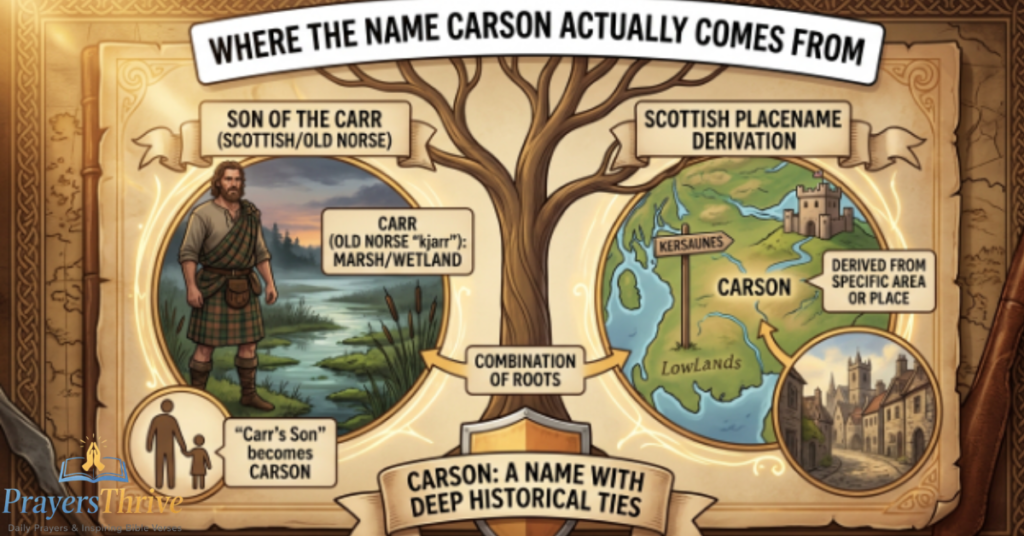
Carson began as a Scottish and Irish surname long before it ever became a first name. Genealogists trace it to the Galloway region of southwestern Scotland, where it likely developed from a Gaelic personal name combined with the patronymic suffix “-son,” meaning “son of.” It later crossed into common use as a given name, following the same path many old surnames took on their way into modern nurseries.
| Root Language | Element | Suggested Meaning |
| Scottish Gaelic | Carr | Rock, or rocky ground |
| Scottish Gaelic (alternate) | Carr | Marsh or fen |
| Old Norse | Kjarr | Brushwood, thicket |
| Patronymic suffix | -son | “Son of,” denoting lineage |
Does Carson Appear in the Bible?
No. Carson has no presence in the Old or New Testament, and it isn’t a Hebrew, Greek, or Aramaic name. Its roots are entirely Celtic. Any biblical meaning attached to Carson today comes from symbolism and interpretation, not from a direct verse or scriptural figure carrying the name.
Two Root Meanings: Rock and Marsh
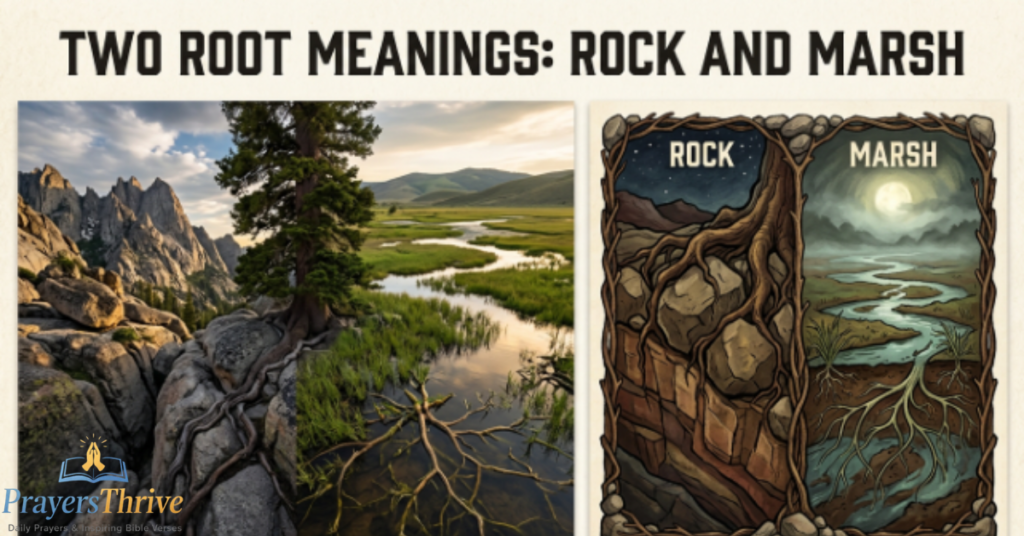
What makes Carson unusually rich for spiritual reflection is that etymologists don’t fully agree on a single meaning. Depending on the source, “carr” is understood either as rocky, elevated ground, or as low, marshy wetland. Rather than treating this as a contradiction, many Christian families see it as two complementary pictures: solid ground to stand on, and difficult terrain to be tested by. Both ideas show up throughout Scripture in ways that make Carson feel unexpectedly at home in a Bible-shaped worldview.
Why “Son of the Rock” Resonates with Scripture
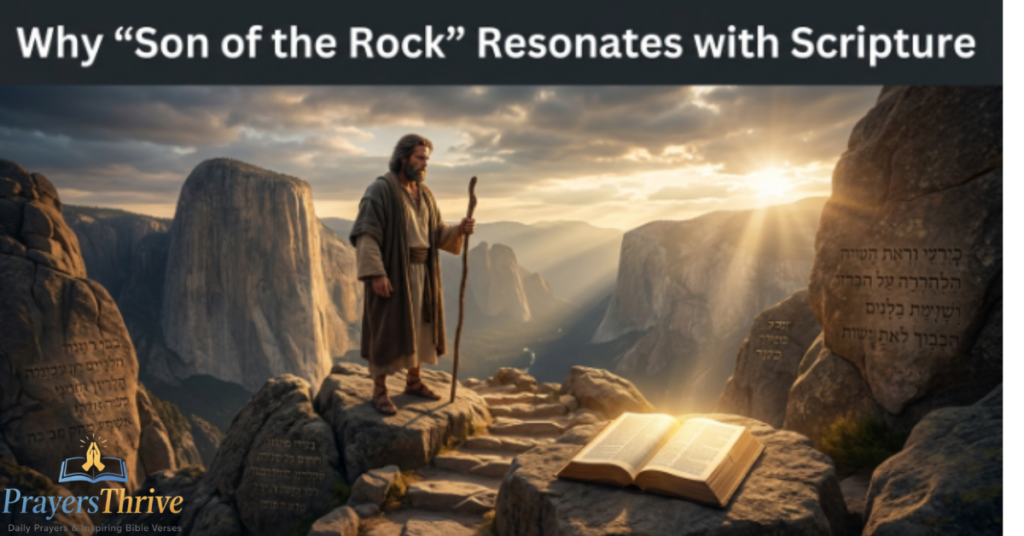
The Bible returns to the image of “the rock” again and again as a symbol of stability, refuge, and unshakable identity. David calls God “my rock and my fortress” in Psalm 18:2. Paul describes Christ as the spiritual rock that followed Israel through the wilderness in 1 Corinthians 10:4. Even Peter’s name, from the Greek petros, plays on this same rock imagery.
For a name that may mean “son of the rock,” this connection isn’t a stretch. It points toward an identity built on something solid rather than shifting, echoing Jesus’ words about the wise builder who set his house on rock instead of sand (Matthew 7:24-25).
Wilderness and Marshland as a Biblical Pattern
If instead you follow the marsh-and-wetland reading of Carson, a different but equally strong biblical pattern appears. Difficult, untamed terrain is where God repeatedly meets His people at their most formative moments:
- Moses spent decades in the wilderness before being called to lead Israel out of Egypt (Exodus 3).
- Elijah retreated into the wilderness at his lowest point, and it was there that God provided rest, food, and renewed purpose (1 Kings 19:4-8).
- John the Baptist’s entire ministry was rooted in the wilderness, both literally and symbolically (Matthew 3:1-3).
- Jesus was led into the wilderness for forty days before His public ministry began (Matthew 4:1-2).
Someone accustomed to marshland learns to move carefully, read the ground, and stay alert, which maps naturally onto a life of faith that requires discernment rather than certainty.
What Carson Symbolizes Spiritually
Pulling both root meanings together, the Carson name symbolism tends to center on a few consistent themes for Christian families:
- Stability — an identity anchored in something firm, echoing the biblical “rock.”
- Resilience — the capacity to navigate hard, uncertain ground without losing footing.
- Inherited identity — the “son of” structure reflects the biblical emphasis on lineage and spiritual inheritance.
- Quiet strength — not loud or showy, but steady and dependable under pressure.
Faith Lessons for Families Choosing the Name Carson
Families drawn to Carson often find that its dual symbolism offers practical spiritual encouragement, not just etymology.
Standing on something solid matters. A life built on Scripture, not shifting circumstances, is the picture behind “son of the rock,” and it mirrors Jesus’ own teaching on wise foundations.
Hard ground is not wasted ground. Whether it’s a wilderness season or a literal marsh, the Bible consistently shows God doing His deepest work in difficult terrain rather than avoiding it.
Endurance is treated as a strength, not a burden. James 1:2-4 frames trials as something that produces maturity, a theme that pairs naturally with a name rooted in tough, testing landscapes.
Identity is inherited, not invented. The patronymic “-son” ending reflects a biblical pattern of identity through family and belonging, pointing toward verses about being called children of God (1 John 3:1).
Biblical Figures Whose Story Mirrors Carson’s Meaning
No biblical figure is named Carson, but several carry the same qualities the name is thought to symbolize.
| Figure | Quality Reflected | Reference |
| David | Trusting God as “my rock” through danger | Psalm 18:2 |
| Moses | Formed through decades in the wilderness | Exodus 3 |
| Elijah | Renewed strength found in isolation | 1 Kings 19:4-8 |
| Peter | An identity built around the image of rock | Matthew 16:18 |
| Job | Endurance refined through prolonged hardship | Job 23:10 |
Real People Who Have Carried the Name
Carson has a well-documented history as both a surname and a given name in the English-speaking world.
- Kit Carson (1809-1868) — an American frontiersman and guide whose reputation for navigating difficult, unfamiliar terrain closely mirrors the “marsh” reading of the name.
- Rachel Carson (1907-1964) — a marine biologist and author whose writing on the natural world helped launch the modern environmental movement.
- Johnny Carson (1925-2005) — longtime host of The Tonight Show, whose three-decade run made the name widely recognizable in American households.
- Carson McCullers — an acclaimed American novelist known for stories exploring isolation and resilience, themes that align closely with the name’s symbolic roots.
Living Out Carson’s Meaning in Daily Faith
For someone carrying the name, this symbolism doesn’t have to stay abstract. It can shape how faith actually gets lived out:
- Treating Scripture as the “rock” a daily routine is built on, rather than an occasional reference point.
- Viewing hard seasons as formative rather than purely as obstacles to escape.
- Leading quietly and consistently rather than through loud declarations.
- Staying dependable for others, the way solid ground stays dependable underfoot.
Philippians 4:13, Joshua 1:9, and Psalm 18:2 are three verses many Christian families connect directly to the spirit of the name.
Nicknames for Carson
- Cars
- Car
- Sonny
- Cass
- Cadey
- C.J.
- Kace
Middle Names That Pair Well with Carson
| Middle Name | Full Name | Why It Fits |
| Michael | Carson Michael | Strong, protective, timeless |
| Elijah | Carson Elijah | Deep spiritual resonance |
| Grace | Carson Grace | Balances strength with softness |
| Daniel | Carson Daniel | Steady, faith-rooted classic |
| Wade | Carson Wade | Echoes the marshland origin |
| Reid | Carson Reid | Sharp, Scottish-heritage pairing |
| Hope | Carson Hope | Pairs strength with encouragement |
Is There an Arabic Connection to Carson?
Carson has no Arabic linguistic roots and isn’t a traditional Arabic name. When it’s used in Arabic-speaking contexts, it’s typically transliterated phonetically rather than translated for meaning. That said, the core qualities associated with Carson, steadiness, endurance, and quiet strength, overlap with values honored across Arabic naming traditions, even without a direct etymological link.
Finding a Hebrew Equivalent to Carson
Carson has no Hebrew origin either; its roots are entirely Celtic. Families looking for a Hebrew name that carries a similar spirit sometimes point to names built around strength or steadfastness, such as Hezekiah (“God is my strength”) or Amir (“strong, one who commands”). These aren’t translations of Carson, but they capture a related spiritual tone for anyone wanting a Hebrew-rooted alternative with comparable meaning.
Is Carson a Good Choice for a Boy or a Girl?
Carson has functioned primarily as a boy’s name for the past several decades and has held a steady spot inside the top 150 boys’ names in the United States for many years. It also sees modest use as a girl’s name, making it one of a growing number of surname-turned-given names used across genders. Its clean, single-syllable-plus-suffix structure pairs easily with a wide range of middle names, which has helped its crossover appeal.
Final Thoughts
Carson will never be a name you find printed in Scripture, but that hasn’t stopped it from carrying real spiritual meaning for the families who choose it. Whether you lean toward the “rock” reading or the “marsh” reading, both point to the same underlying truth the Bible keeps returning to: strength that’s built on something solid, and endurance that’s shaped by hard ground rather than broken by it.
For a family naming a child Carson, or for anyone carrying the name themselves, that’s a meaningful inheritance, not a label handed down by accident, but a quiet reminder that steadiness and resilience have always been part of what it means to walk faithfully, one uncertain step at a time.
see also: 100+ Touching Birthday Wishes for a Pastor with Blessings
FAQs
Does the name Carson appear in the Bible?
No. Carson has Celtic origins and does not appear as a name in Scripture, though believers often connect its meaning to biblical themes.
What does Carson mean spiritually?
Depending on which root is emphasized, Carson is associated either with solid, rock-like stability or with resilience forged through difficult terrain, both strong biblical themes.
Is Carson considered a Christian name?
It isn’t biblical by origin, but many Christian families embrace it for the faith-aligned symbolism of strength, endurance, and inherited identity.
What language does Carson come from?
Carson comes from Scottish and Irish Gaelic, likely tied to the word “carr,” meaning either rock or marsh, combined with the patronymic “-son.”
Is Carson more common for boys or girls?
Carson is used far more often for boys, though it has a smaller but steady presence as a girl’s name as well.
Are there Bible verses associated with the Carson meaning?
Psalm 18:2, Joshua 1:9, and Matthew 7:24-25 are commonly cited by families drawing a connection between Carson and biblical themes of strength and foundation.

I’m Aria, an AI content writing expert with 3 years of experience, creating engaging and inspiring faith-based content for readers seeking prayers, blessings, and Bible insights.