
Have you ever felt drawn to a name without knowing why?
Maybe you are thinking about naming your baby Tristan. Maybe someone close to you carries this name. Or maybe you simply searched — what does Tristan mean in the Bible?
Whatever brought you here, you are asking the right question.
In the Bible, names carry real weight. They reflect identity, purpose, and divine meaning. God renamed Abram to Abraham. He told Mary exactly what to name her son. Names in Scripture are never just labels — they are declarations.
So if Tristan has been on your heart, there is likely a reason.
In this article, we will explore the Tristan name meaning Bible — its spiritual symbolism, Hebrew connections, and what Scripture says about the sorrow and strength this name represents.
What Does the Name Tristan Mean?
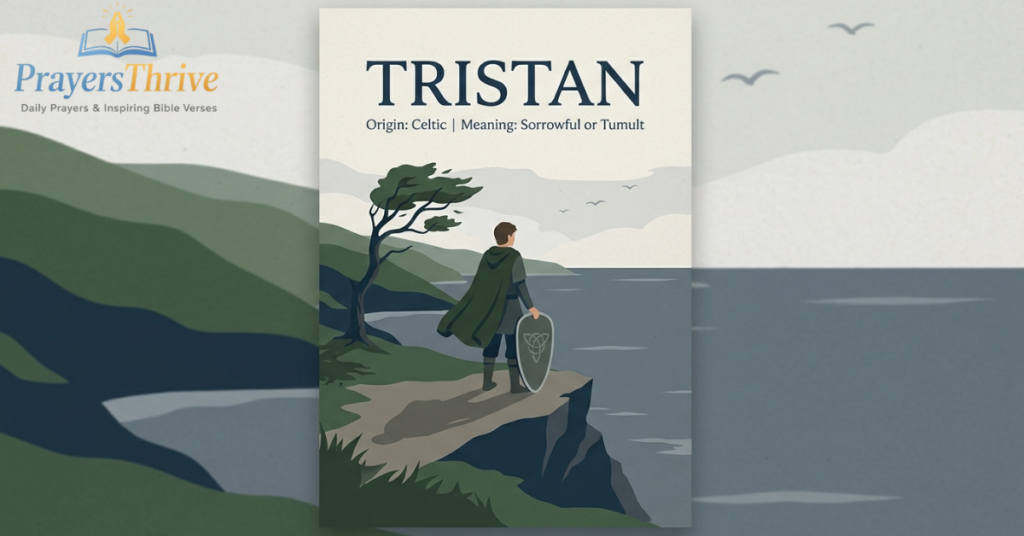
The name Tristan comes from Old Celtic and Old French roots. It is traditionally connected to the word triste, which means sorrowful or deeply emotional. Historically, Tristan became well-known through the medieval legend of Tristan and Isolde — a story built on themes of devotion, sacrifice, and deep emotional loyalty.
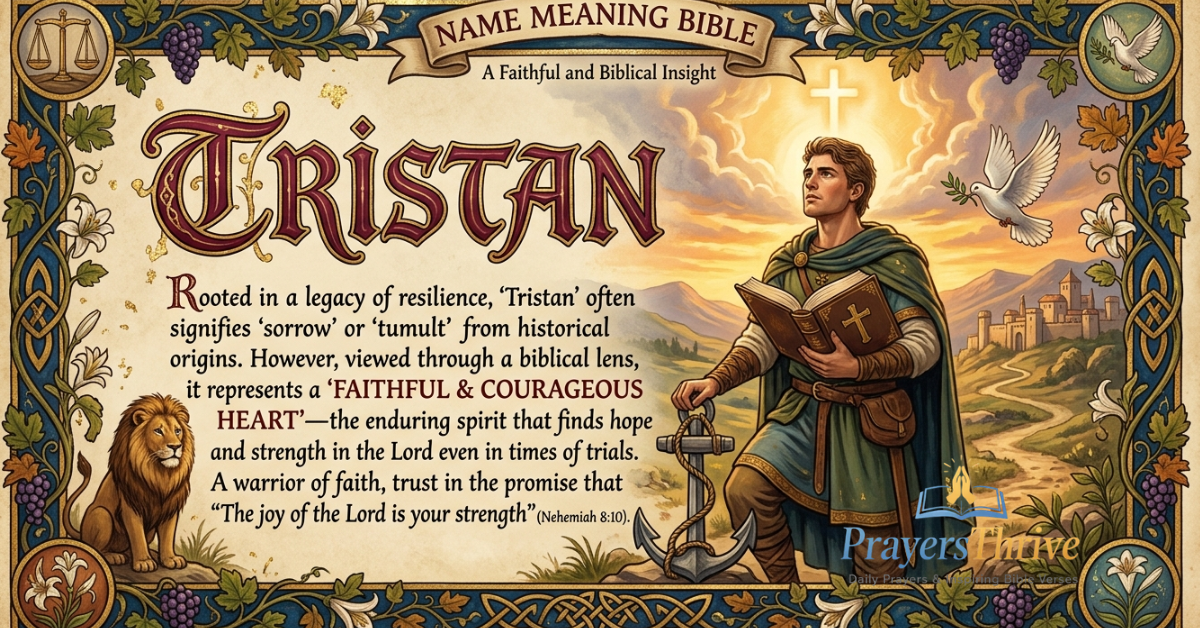
But the meaning of Tristan goes beyond simple sadness. In a deeper sense, it describes someone who carries emotional depth, strong empathy, and inner resilience. These are qualities that align beautifully with a life of faith.
People named Tristan are often described as:
- Sensitive and emotionally intelligent
- Deeply loyal and devoted
- Strong in the face of personal trials
- Compassionate toward others who are hurting
So while the literal root means sorrow, the full picture of Tristan is someone shaped by life’s difficulties into a person of depth and strength.
Is Tristan a Biblical Name?
Let’s be honest and clear from the start.
The name Tristan does not appear anywhere in the Bible. You will not find it in the Old Testament or the New Testament. It is not a Hebrew name, and it is not of biblical origin.
However, that does not mean it carries no spiritual value.
Many beloved Christian names — like Emily, Nathan, or Grace — are not taken directly from Scripture, yet they carry rich spiritual meaning when viewed through a biblical lens. The same is true for Tristan.
What matters spiritually is not whether a name appears word-for-word in the Bible, but whether its meaning connects with God’s truth.
And Tristan does.
Tristan Name Meaning Bible: The Spiritual Connection
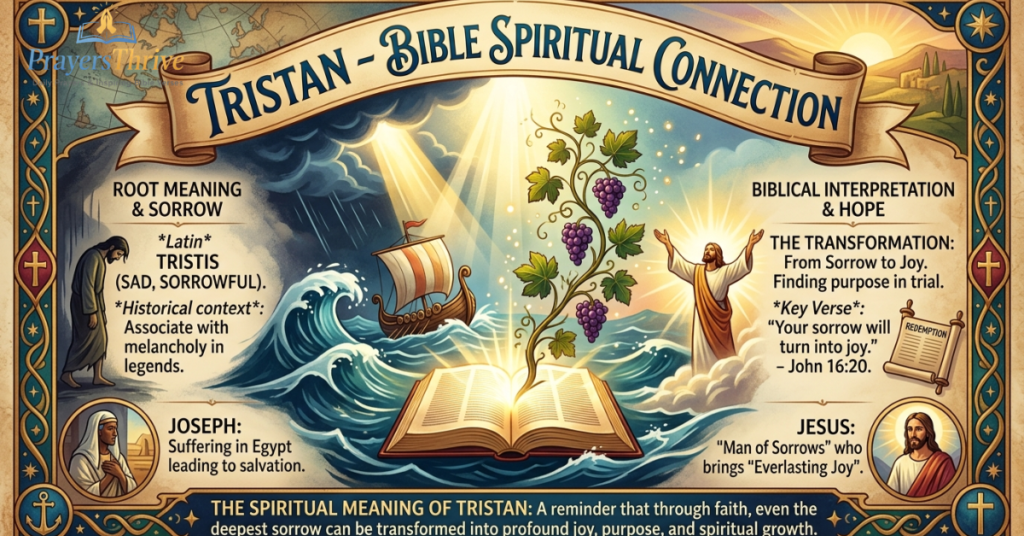
When we look at Tristan through the Bible, its meaning becomes something powerful — not dark, not hopeless, but deeply redemptive.
The core meaning of Tristan is sorrow. And in the Bible, sorrow is not a sign of weakness. It is often the very place where God shows up most powerfully.
Psalm 34:18 says: “The Lord is close to the brokenhearted and saves those who are crushed in spirit.”
This single verse transforms the meaning of Tristan entirely. A name linked to sorrow is also a name linked to God’s closeness. Wherever there is deep grief, God draws near.
Romans 8:18 adds: “The sufferings of this present time are not worth comparing with the glory that will be revealed in us.”
So biblically, sorrow is always temporary. It always points toward something greater — healing, growth, and eternal glory.
For anyone named Tristan, this is a meaningful foundation: your name does not define you as someone trapped in sadness. It defines you as someone who understands pain and has been positioned by God to walk through it with faith.
Tristan Meaning in Hebrew
Tristan is not a Hebrew name, but we can still explore its meaning through Hebrew biblical thought — because Hebrew spirituality offers some of the deepest frameworks for understanding sorrow and transformation.
Sorrow in Hebrew Thought
In Hebrew, the concept of sorrow is often tied to the word yagon (יָגוֹן), meaning grief or anguish, or tza’ar (צַעַר), meaning pain or distress. These are not shameful states in Hebrew thinking — they are honest expressions of the human heart before God.
The Psalms, which are deeply rooted in Hebrew emotion, are filled with raw sorrow poured out before God. David, a man after God’s own heart, wrote in Psalm 22:1 — words that even Jesus spoke on the cross — expressing the depth of human pain in the presence of God.
What does this mean for the name Tristan in a Hebrew context?
It means that sorrow is not something to hide. It is something to bring honestly before God. A person whose name connects to sorrow — like Tristan — carries the invitation to practice this kind of deep, honest prayer.
Transformation Through Trials
Hebrew spirituality deeply values the idea of refinement. Just as gold is purified through fire, so the human soul is shaped through trials. This is not a punishment — it is a process of becoming.
The name Tristan, when viewed through this lens, represents:
- A soul being refined through difficulty
- A heart growing in wisdom through pain
- A faith made stronger through honest struggle
This is not a heavy meaning. This is a hopeful one.
Tristan Meaning in Greek
Like its Hebrew counterpart, Tristan has no direct Greek root either — the name’s story runs through Latin and Celtic Europe, not the Greek New Testament. So when someone asks what does Tristan mean in Greek, the honest answer is the same as with Hebrew: there isn’t a linguistic connection. But the theme behind the name — sorrow that doesn’t stay sorrow — is written all through Greek Scripture.
The New Testament uses a specific word for this kind of grief: lupē (λύπη), the sorrow Jesus describes when he tells his disciples, “your sorrow shall be turned into joy” (John 16:20, KJV). It’s the same word Paul uses for “godly sorrow” in 2 Corinthians 7:10 — grief that leads somewhere, rather than grief that simply sits.
There’s a second word worth knowing: thlipsis (θλῖψις), often translated “tribulation” — literally a pressing, or a weight. Jesus uses it in John 16:33: “in the world ye shall have tribulation: but be of good cheer.” Thlipsis isn’t despair. It’s pressure with a purpose, the same idea Paul builds on in Romans 5:3-4.
So while the Tristan meaning in Bible Greek isn’t a matter of translation, Hebrew and Greek end up telling the same spiritual story from two directions — Hebrew grief that waits on God, Greek sorrow that turns into joy.
If you want to sit with the word lupē a little longer, Blue Letter Bible’s word study on thlipsis breaks down every place these Greek words for sorrow and tribulation appear across the New Testament, verse by verse. And rather than reading John 16:20 as a single line pulled out of context, BibleGateway’s full text of John 16 lets you read the whole conversation Jesus is having with His disciples, in whichever translation you’re most comfortable with.
Names carry this same kind of weight throughout Scripture, and Tristan is far from the only one worth this kind of digging. If a name has been on your mind lately — your own, a partner’s, or one you’re choosing for a child — Stella, Jocelyn, and Mason get the same treatment elsewhere on this site — origin, biblical connection (or the honest lack of one), and what the meaning might say about the person carrying it.
Biblical Themes Connected to the Name Tristan

Even though Tristan is not in the Bible, several major biblical themes connect directly to its meaning. These themes give the name rich spiritual texture.
1. God Is Near in Sorrow
The Bible repeatedly shows that God does not abandon people in their pain. He draws near. He listens. He comforts.
In Matthew 5:4, Jesus said: “Blessed are those who mourn, for they will be comforted.”
This Beatitude is stunning. Jesus does not say mourning is shameful. He calls those who mourn blessed — because comfort from God is on the way.
For the name Tristan, this is its first biblical truth: sorrow opens the door to divine comfort.
2. Pain Produces Growth
The Bible is clear that trials are not wasted. They serve a purpose in God’s plan for our lives.
James 1:2-4 says: “Consider it pure joy, my brothers and sisters, whenever you face trials of many kinds, because you know that the testing of your faith produces perseverance. Let perseverance finish its work so that you may be mature and complete, not lacking anything.”
Someone named Tristan can carry this truth as part of their identity: trials are not the end of the story. They are the beginning of maturity.
3. Compassion Is Born From Suffering
People who have walked through pain often become the greatest sources of comfort for others.
2 Corinthians 1:3-4 says: “Praise be to the God and Father of our Lord Jesus Christ, the Father of compassion and the God of all comfort, who comforts us in all our troubles, so that we can comfort those in any trouble with the comfort we ourselves receive from God.”
The name Tristan spiritually points toward this calling — someone who has experienced sorrow becomes someone who can truly comfort others. That is a gift, not a burden.
4. Jesus Himself Wept
One of the shortest yet most powerful verses in Scripture is John 11:35:
“Jesus wept.”
Even the Son of God, fully divine, felt deep sorrow. He stood at the tomb of Lazarus and wept. He did not perform strength. He allowed himself to feel grief.
This tells us something important: sorrow is not a lack of faith. It is part of being human — and Jesus honored that.
For anyone named Tristan, this is profound. Your name’s meaning is something Jesus himself expressed.
5. Mourning Turns to Dancing
Sorrow in the Bible is never the final word. God always moves from mourning to joy.
Psalm 30:11 says: “You turned my wailing into dancing; you removed my sackcloth and clothed me with joy.”
This is the complete spiritual arc of the name Tristan — not someone stuck in sadness, but someone whose journey moves from sorrow toward joy, from trials toward triumph.
What Does Tristan Mean in the Bible for Your Life?

Whether you carry this name yourself, are considering it for a child, or simply felt drawn to it spiritually, the meaning of Tristan holds real encouragement for your faith walk.
Here is what it can represent for your personal spiritual life:
You are someone who feels deeply. That sensitivity is not a weakness. It is a spiritual gift that allows you to pray deeply, love genuinely, and serve others with real compassion.
You may walk through difficult seasons. But those seasons are not signs that God has left. They are signs that God is working. Refinement, not rejection.
You are positioned to comfort others. The pain you walk through becomes the credential that allows you to sit with others in their pain without flinching.
Your sorrow will not last forever. God’s promise is restoration. His character is to turn mourning into joy, ashes into beauty, and sorrow into songs of praise.
Tristan in Dreams: What Could It Mean?

Some people come to this topic because they heard the name Tristan in a dream and want to understand its spiritual significance.
In Christian dream interpretation, names that appear in dreams often carry symbolic meaning related to the dreamer’s current season of life or a message from God.
If you dreamed about the name Tristan and the dream felt peaceful or warm, it may indicate:
- A season of healing is beginning
- God is affirming your emotional journey
- Restoration is near after a period of difficulty
If the dream felt heavy or serious, it may point toward:
- An invitation to bring hidden grief to God in prayer
- A call to deeper spiritual honesty
- A reminder that God is present in a difficult season you are walking through
Always bring dreams to prayer and ask God for clarity. His messages bring peace, not fear, and always align with Scripture.
Is Tristan a Good Name for a Christian Baby?
This is one of the most common questions people ask when researching the Tristan name meaning Bible.
The answer is yes — Tristan is a meaningful name for a Christian child.
Here is why:
It carries themes of emotional depth, spiritual growth, and transformation — all of which are deeply biblical values. Many great men and women of faith in the Bible walked through sorrow before stepping into their God-given purpose. Job, David, Joseph, Ruth, Paul — all of them knew suffering. All of them emerged with deeper faith.
A child named Tristan carries a name that, when understood spiritually, tells a story of resilience, compassion, and hope. That is a powerful identity to give a child.
Paired with Scripture and prayer, the name Tristan becomes not just a label but a spiritual declaration: This child will know difficulty, and through it, will become someone of great depth, faith, and purpose.
Other Bible Names That Also Mean Sorrow
Tristan isn’t the only name built on a hard word. Scripture itself includes real people whose names carried the weight of grief long before Latin or Celtic Europe existed — and their stories are proof that a name’s meaning is a starting point, not a life sentence.
Jabez (1 Chronicles 4:9-10) was named for the pain his mother experienced during childbirth — his name is tied directly to the Hebrew word for sorrow. Yet Jabez is remembered not for that pain but for the bold prayer he prayed asking God to enlarge his territory and keep him from harm. Scripture says God granted it.
Naomi renamed herself Mara — “bitter” — after losing her husband and both sons (Ruth 1:20). It was an honest name for an honest season. But her story doesn’t end there. It continues into one of the Bible’s clearest pictures of restoration, through Ruth and Boaz.
Both names started in sorrow. Neither stayed there. That’s the same arc the Tristan name meaning Bible points toward — a name that begins in grief is not a name without a future.
Spiritual Lessons From the Meaning of Tristan

Let’s gather the key biblical takeaways from this name and make them practical for everyday faith:
God is always near in sorrow. You are never abandoned in your grief.
Pain has divine purpose. Nothing you walk through is wasted in God’s hands.
Emotional depth is a strength. People who feel deeply pray deeply and love deeply.
Compassion grows through difficulty. Your trials prepare you to serve others well.
Sorrow is temporary. Joy comes — not as wishful thinking, but as God’s promise.
Honest prayer matters. Bring your real emotions to God. He can handle them.
Faith is not the absence of tears. Even Jesus wept. Faith is trusting God while the tears fall.
Frequently Asked Questions
Is Tristan a biblical name?
No, Tristan does not appear in the Bible. But its meaning connects strongly with biblical themes of sorrow, faith, endurance, and restoration.
What does Tristan mean spiritually?
Spiritually, Tristan represents emotional depth, compassion born from personal pain, and a faith that grows stronger through difficult seasons.
Is Tristan in the Bible?
There is no person named Tristan in Scripture. However, the values connected to its meaning — sorrow leading to strength, trials leading to growth — are central to biblical teaching.
Is Tristan a good name for a Christian?
Yes. While not originally a biblical name, Tristan carries themes that align beautifully with Christian faith, character, and spiritual growth.
What does dreaming of the name Tristan mean?
It may reflect a season of healing, a call to deeper prayer, or God’s reminder of His nearness during emotional difficulty.
What does Tristan mean in Hebrew?
Tristan is not a Hebrew name, but through Hebrew biblical thought it connects to ideas of honest grief before God and spiritual refinement through trials.
What does Tristan mean in Greek?
Tristan has no root in Greek, just as it has none in Hebrew — the name developed later, through Latin and Celtic Europe. That said, the Greek New Testament has rich language for the same theme the name touches on, especially the word lupē (sorrow) and the promise in John 16:20 that sorrow turns into joy.
Is Tristen or Tristin the same name as Tristan?
Yes. Tristen and Tristin are simply modern spelling variations of Tristan — same origin, same meaning, same non-biblical status. Everything in this article applies equally, whichever spelling you’re drawn to.
Conclusion
The Tristan name meaning Bible is not found in a single verse — because Tristan is not a biblical name. But when you explore its meaning through the truth of Scripture, something beautiful emerges.
Sorrow is not the end. It is the beginning of something God is building.
The name Tristan carries a meaning that points toward emotional depth, honest faith, compassion for others, and a journey that moves from darkness to light — from mourning to dancing, as God Himself promises.
If this name has touched your heart — whether for yourself, your child, or a dream — bring it to God in prayer. Ask Him what He is saying to you through it.
He is always speaking. He is always near. And He never wastes a single tear.
“The Lord is close to the brokenhearted and saves those who are crushed in spirit.” — Psalm 34:18

I’m Aria, an AI content writing expert with 3 years of experience, creating engaging and inspiring faith-based content for readers seeking prayers, blessings, and Bible insights.