
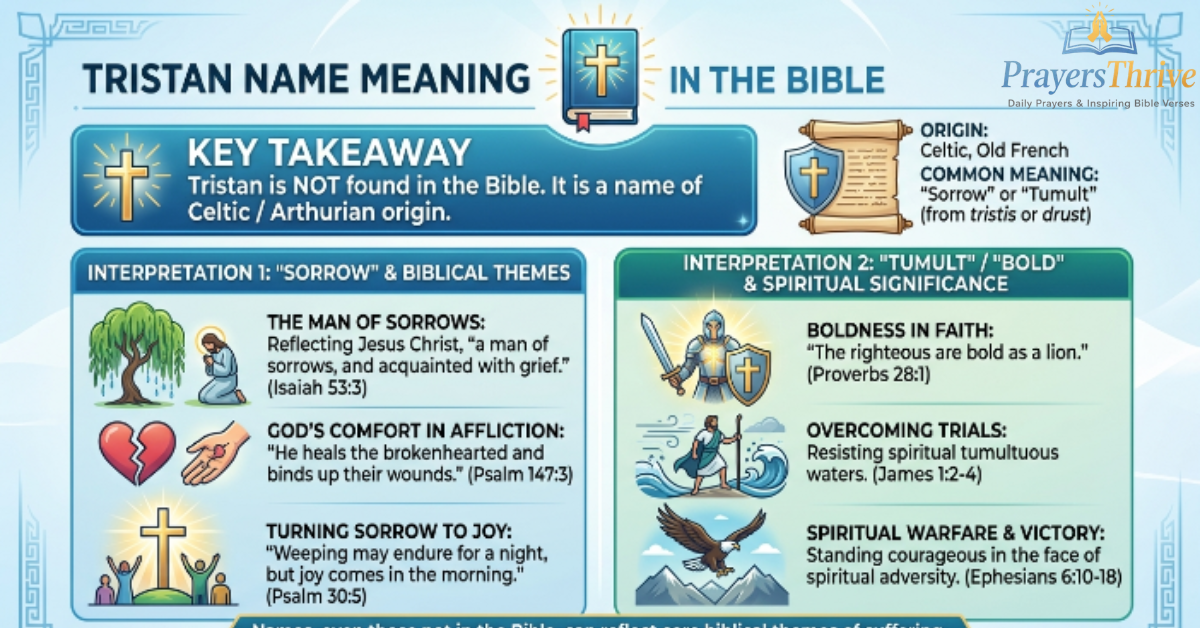
Have you ever felt a sudden pull toward a name — hearing it in a dream, meeting someone who carries it, or finding it appear at the most unexpected moment? The name Tristan carries that kind of quiet power.
While Tristan is not written in the pages of Scripture, its spiritual meaning runs deep through Biblical truth. God speaks in many ways — through names, dreams, nature, and moments of stillness. Understanding what a name carries can open a door to deeper faith and personal clarity.
This guide explores the Biblical meaning of Tristan, its spiritual roots, dream symbolism, and how it connects to God’s promises in Scripture.
What Does Tristan Mean? (Origin & Root)

The name Tristan traces back to Celtic and Old French roots, most commonly linked to the word drest or trystan, meaning “noise,” “tumult,” or “sorrowful.” Some scholars also connect it to the Latin tristis, meaning sadness or grief.
In the ancient world, names were not chosen casually. They reflected character, destiny, and divine intention. A name rooted in sorrow did not carry shame — it carried purpose.
The Biblical world understood this deeply. Names like Jabez (meaning “pain”) and Ichabod (meaning “the glory has departed”) show that even difficult names can carry seeds of transformation and divine grace.
Tristan name origin, Tristan Celtic meaning, Tristan Latin root, meaning of Tristan spiritually
What About the Tristan and Isolde Legend?
If you’ve read anything about this name’s history, you’ve likely come across the medieval legend of Tristan and Isolde — the tragic, centuries-old love story that made the name famous across Europe. It’s worth addressing honestly, because the story itself is not one Scripture would endorse: it centers on a forbidden love triangle set in motion by a love potion, and its values don’t reflect Christian teaching on marriage or faithfulness.
Here’s the reassurance: a name’s medieval popularity doesn’t inherit a story’s morality. David, Samson, and Jacob are all genuine biblical names — and all three men are remembered for serious, well-documented failures alongside their faith. Their names are still chosen today with pride, not because their mistakes are excused, but because a name’s meaning for a child comes from the character and faith spoken over them, not from every story that happens to share its spelling.
Tristan Name Meaning in the Bible
Tristan does not appear directly in Scripture — but this does not make it spiritually empty. Many names carry Biblical resonance without a direct Biblical mention.
What matters is how the name’s core meaning aligns with God’s Word.
The root meaning of sorrow or tumult in Tristan connects powerfully to one of the most consistent themes across Scripture: God working through hardship to bring transformation.
Consider these Biblical truths that mirror Tristan’s spiritual core:
- Sorrow becomes joy — “You turned my wailing into dancing.” (Psalm 30:11)
- Pain carries purpose — “For I know the plans I have for you, declares the Lord.” (Jeremiah 29:11)
- Suffering builds strength — “We also glory in our sufferings, because we know that suffering produces perseverance.” (Romans 5:3)
In this light, the name Tristan is not a mark of grief — it is a promise of redemption through difficulty.
Tristan Isn’t Alone: Other Names That Aren’t in Scripture Either
It’s worth putting this in perspective. Countless names Christian families use every day never appear in the Bible at all — and nobody questions the faith behind them.
| Name | Origin | Found in Scripture? |
|---|---|---|
| Madison | English surname | No |
| Kimberly | Old English place name | No |
| Nevaeh | Modern coinage (“heaven” spelled backward) | No |
| Christian | Used only to describe believers in Acts 11:26, never as a personal name | No |
A name doesn’t need a verse next to it to carry real spiritual weight — what matters is the character and the faith spoken over the person who carries it. That’s exactly the case Tristan makes for itself.
If a name has been on your heart lately — your own, a partner’s, or one you’re choosing for a child — Stella, Jocelyn, and Mason get this same exploration elsewhere on this site.
Spiritual Symbolism of Tristan

From a spiritual perspective, the name Tristan symbolizes three core themes:
1. Perseverance Through Trials
Tristan’s meaning of tumult reflects the storms of life. Spiritually, those who carry this name — or encounter it — are often being called to stand firm when circumstances feel uncertain. The Bible affirms this call repeatedly, from Job’s patience to Paul’s contentment in all situations (Philippians 4:11).
2. Transformation of Sorrow
God is a God who redeems. The name Tristan, rooted in grief, becomes a living testimony that He can turn mourning into meaning. This is the spiritual heartbeat of the name — not despair, but divine reversal.
3. Compassionate Strength
People drawn to the name Tristan often carry a deep sensitivity toward others who are suffering. This is a spiritual gift — the ability to sit with people in pain and offer genuine hope, much like the prophet Elijah did for the widow of Zarephath (1 Kings 17:10–16).
Tristan spiritual meaning, Tristan symbolism Christianity, what does Tristan represent spiritually, Tristan faith meaning
Biblical Characters Who Reflect Tristan’s Meaning
Although Tristan never appears in Scripture by name, several Biblical figures embody what this name spiritually represents:
Job — He walked through unimaginable loss and sorrow, yet held onto faith. His story mirrors the core of Tristan’s meaning: that suffering is not the final word.
Joseph — Rejected, enslaved, and imprisoned. Yet every trial was preparation for divine purpose. His life is the clearest Biblical picture of tumult becoming triumph.
Hannah — Her years of barrenness were marked by deep grief. Yet her tears became the foundation of one of Israel’s greatest prophets. God heard her sorrow and responded with abundance (1 Samuel 1:10–20).
King David — A man who wrote “My God, my God, why have you forsaken me?” (Psalm 22:1) — yet also “The Lord is my shepherd.” (Psalm 23:1). David lived the full spectrum of Tristan’s meaning: from anguish to assurance.
Each of these lives carries the same message — sorrow is not a destination. It is a doorway.
If you’re also exploring names of resilience, Heather’s Biblical meaning carries a similar spirit of quiet strength.
Tristan in Dreams What It Signifies

Dreams have carried spiritual messages throughout Biblical history. God spoke to Joseph through dreams, to Daniel through visions, and to the wise men through heavenly guidance (Matthew 2:12).
If the name Tristan appears in your dream, consider these possible interpretations:
A peaceful dream featuring Tristan — This may be a gentle reassurance from God. He is saying: your trials are not forgotten. Your perseverance is seen. Rest in that promise.
A turbulent or distressing dream involving Tristan — This could be a spiritual call to examine where you are avoiding difficulty. God may be inviting you to lean into a challenging situation with faith rather than fear.
Hearing the name spoken aloud in a dream — In Biblical tradition, God calling a name carried significant weight (Genesis 22:11, 1 Samuel 3:10). This may be a moment of divine attention — an invitation to draw closer, pray more intentionally, and listen.
Dreams are personal and spiritual discernment is always required. Bring what you receive in a dream to prayer, Scripture, and trusted spiritual counsel.
Tristan in dreams Biblical, dreaming of name Tristan meaning, spiritual dream interpretation name Tristan
Curious about other names appearing in dreams? Alora’s Biblical dream symbolism explores this same territory.
Tristen: Variant Spelling, Same Sacred Meaning
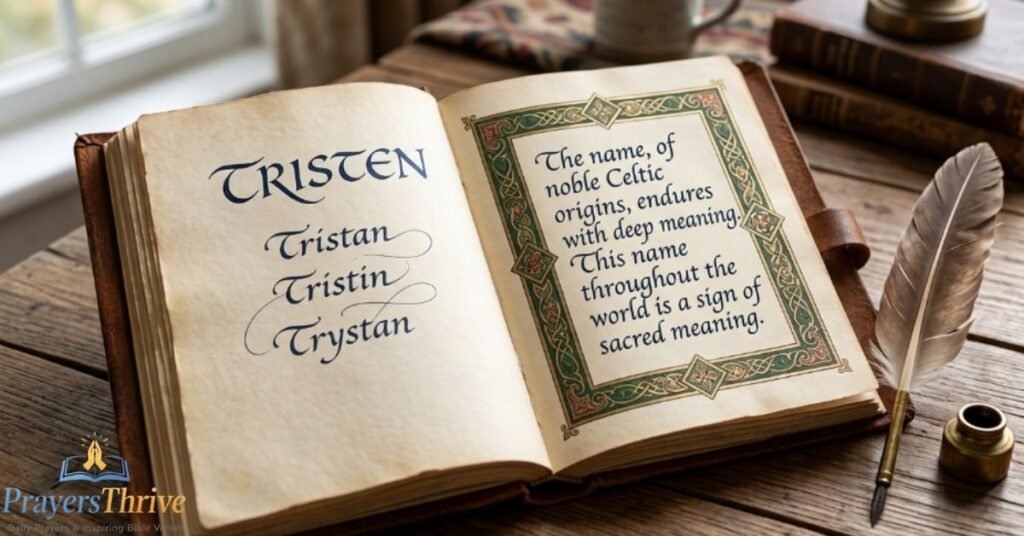
The spelling Tristen is a modern variant of Tristan, widely used across North America and the UK. The spiritual and Biblical meaning remains identical.
Whether written as Tristan or Tristen, the name carries:
- A calling toward resilience in difficult seasons
- A heart inclined toward empathy and serving others
- A spiritual invitation to trust God’s process even when the path is unclear
The variation in spelling does not diminish the depth of meaning. God knows every name — and every person — by heart.
Does Tristan Have a Hebrew or Greek Meaning?
Tristan’s roots are Celtic and Old French, not Hebrew or Greek. Because so many names carry Biblical weight through Hebrew or Greek origins, it’s natural to search for that connection here too. While Tristan doesn’t have a direct Hebrew or Greek root, its spiritual meaning still stands firmly on Biblical themes of sorrow transformed into purpose — the same truth carried by names that do have ancient Hebrew or Greek roots. The spelling “Tristian” is also sometimes used and carries this exact same meaning.
Key Bible Verses Connected to Tristan
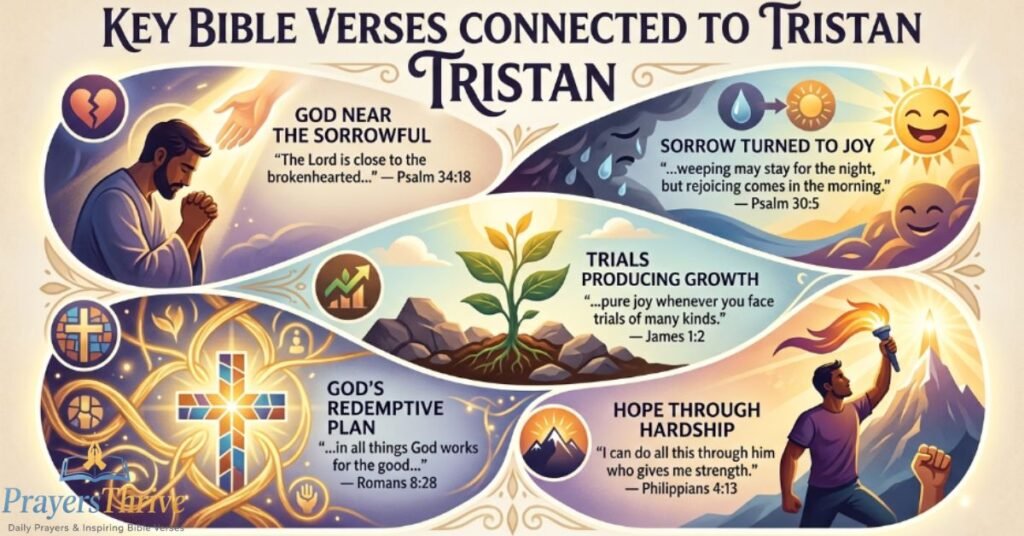
These Scripture passages speak directly to the spiritual themes embedded in the name Tristan:
| Theme | Bible Verse |
| God near the sorrowful | “The Lord is close to the brokenhearted and saves those who are crushed in spirit.” — Psalm 34:18 |
| Sorrow turned to joy | “Weeping may stay for the night, but rejoicing comes in the morning.” — Psalm 30:5 |
| Trials producing growth | “Consider it pure joy whenever you face trials of many kinds.” — James 1:2 |
| God’s redemptive plan | “And we know that in all things God works for the good of those who love him.” — Romans 8:28 |
| Hope through hardship | “I can do all this through him who gives me strength.” — Philippians 4:13 |
These verses are not simply inspirational quotes — they are the Biblical architecture of what Tristan’s spiritual meaning is built upon.
Practical Faith Lessons from the Name Tristan

Understanding a name’s meaning is only valuable when it shapes how we live. Here are actionable lessons drawn from Tristan’s Biblical and spiritual significance:
1. Reframe your trials.
When hardship arrives, ask: What is God building in me through this? Tristan’s meaning invites a shift in perspective — from why is this happening to what is this forming.
2. Pray through sorrow, not around it.
The Bible never asks us to pretend pain does not exist. David wept. Hannah wept. Jesus wept (John 11:35). Authentic prayer acknowledges difficulty and brings it to God honestly.
3. Use your experience to comfort others.
Those shaped by suffering often carry extraordinary capacity for empathy. The Apostle Paul wrote, “He comforts us in all our troubles, so that we can comfort those in any trouble.” (2 Corinthians 1:4). Your pain has a purpose beyond yourself.
4. Trust the process, not just the outcome.
Tristan’s root meaning of tumult reminds us that seasons of chaos do not indicate the absence of God. They often indicate His active work in our lives.
5. Anchor in Scripture during uncertain seasons.
When the name Tristan resonates with you — through a dream, a person, or quiet reflection — return to God’s Word. Let His promises be louder than your circumstances.
Want to explore another name’s spiritual depth? Madison’s Biblical meaning is worth reading next.
FAQs
Is Tristan found anywhere in the Bible?
No, Tristan does not appear in Scripture. However, its root meaning — sorrow, tumult — aligns deeply with Biblical themes of faith through hardship, God’s redemptive nature, and the transformation of grief into purpose.
What is the spiritual meaning of the name Tristan?
Spiritually, Tristan represents perseverance, compassionate faith, and the Biblical truth that God transforms difficult seasons into something meaningful. It is a name connected to resilience and divine hope.
What does it mean to dream of the name Tristan?
Dreaming of the name Tristan may carry a message of encouragement — that God is present in your trials — or a gentle spiritual nudge to face a difficulty with renewed faith. Context and prayerful reflection are key.
Does the spelling Tristen change the meaning?
No. Tristen and Tristan share the same etymological root and carry identical Biblical and spiritual significance.
Which Bible verse best reflects the meaning of Tristan?
Psalm 34:18 — “The Lord is close to the brokenhearted and saves those who are crushed in spirit” — reflects the heart of Tristan’s meaning most directly. Romans 8:28 and Psalm 30:5 are also closely connected.
Is Tristan a Christian name?
Tristan has Celtic origins and is widely used across Christian communities. While it is not a Biblical name, its meaning connects strongly to Christian values of faith, endurance, and trust in God’s plan.
Does the spelling Tristin carry the same meaning as Tristan?
Yes. Tristin is simply another modern spelling of Tristan, alongside Tristen and Tristian — all trace back to the same Celtic and Latin roots and carry the same spiritual meaning discussed throughout this article.
Conclusion
The name Tristan carries more than a historical root — it carries a spiritual invitation. It is a name that speaks of walking through difficulty with faith intact, of sorrow becoming a doorway rather than a dead end, and of trusting a God who is near to the brokenhearted.
Whether you carry this name, love someone who does, or encountered it in a dream or a quiet moment of reflection — let it point you back to the promises of Scripture. God has never been distant from those who suffer. He has always been closest in the places that hurt most.
Let Tristan be a reminder: the trial is not the end of the story. With God, it is always the beginning of something deeper.

I’m Aria, an AI content writing expert with 3 years of experience, creating engaging and inspiring faith-based content for readers seeking prayers, blessings, and Bible insights.