
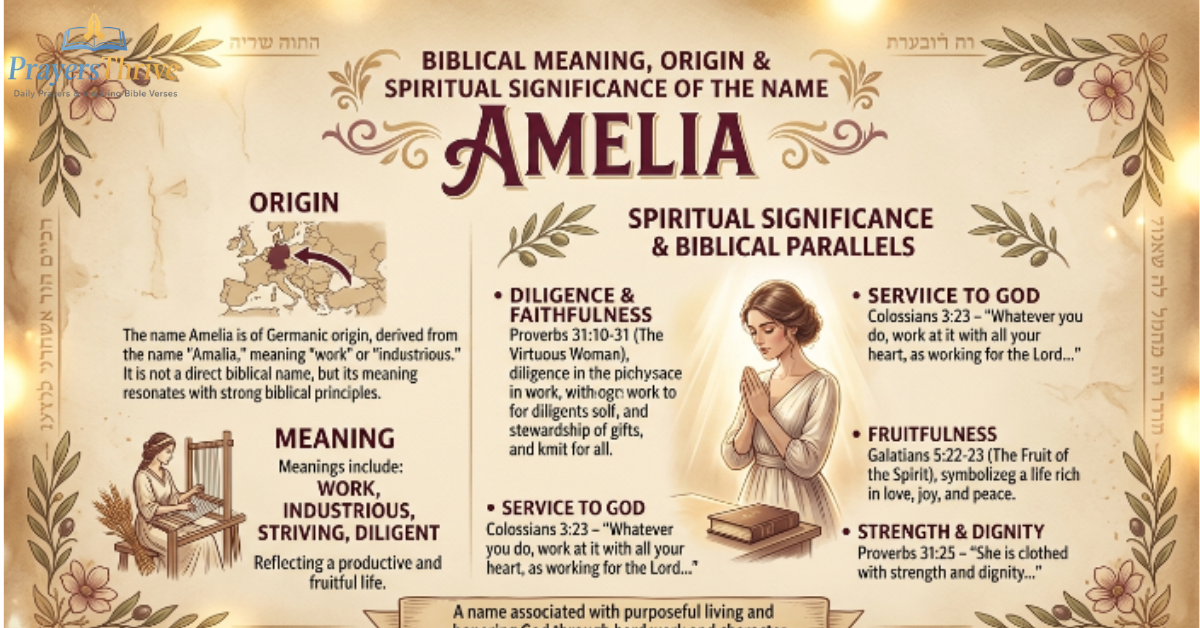
Some names carry a quiet but unmistakable spiritual power — names that, though absent from the pages of Scripture, breathe with the very values and virtues that God celebrates throughout His Word. Amelia is precisely such a name. Elegant in sound, purposeful in meaning, and rich in spiritual resonance, Amelia connects its bearers to a biblical tradition of faithful labor, persevering devotion, and wholehearted service that runs like a golden thread from Genesis to Revelation.
For parents seeking a name that carries genuine spiritual depth, or for anyone named Amelia who wishes to understand the divine calling woven into their identity, exploring the biblical meaning of this beautiful name is a journey worth taking. What emerges is a portrait of a woman called to work with excellence, serve with humility, endure with grace, and trust with the kind of unshakeable faith that transforms ordinary effort into extraordinary spiritual legacy.
see also: 25+ Good Morning Prayer for Him
The Ancient Roots of Amelia and Their Spiritual Echoes
The name Amelia traces its linguistic origins to the ancient Germanic tribal name Amal, which gave rise to the noble Visigothic dynasty known as the Amalings. The root amal carried connotations of vigorous work, industrious effort, and the kind of tireless labor that builds lasting things — families, communities, kingdoms, and legacies that endure beyond a single lifetime.
From this Germanic root, Amelia evolved through Latin and Old French influences into the elegant name recognized across the world today. Its core meaning consistently centers on diligence, industriousness, and purposeful effort — qualities that speak powerfully into biblical values surrounding work, faithfulness, and the God-honoring use of human energy and capability.
It is worth noting that Amelia is sometimes confused with the Hebrew name Amalia, meaning “work of God” or “labor of the Lord.” While linguistically distinct, this Hebrew parallel deepens Amelia’s spiritual resonance considerably. The idea that human labor becomes divine when offered to God in faith and obedience is one of Scripture’s most consistent and beautiful themes, and Amelia’s meaning stands squarely within this sacred tradition.
Throughout European history, Amelia was carried by queens, noblewomen, and figures of cultural significance — most notably Amelia of Great Britain, daughter of King George II, whose bearing of the name contributed to its widespread popularity across the English-speaking world. Yet beyond royal associations and cultural prestige, Amelia’s truest and most enduring significance lies in what it spiritually represents — a life of meaningful, God-directed work that leaves the world richer for having been lived.
What the Bible Says About Diligent, Purposeful Work
The most foundational spiritual theme embedded in the name Amelia is the biblical theology of work — a subject that Scripture addresses with far greater depth, nuance, and celebration than most believers realize. From the very opening chapters of Genesis, work is established not as a consequence of the Fall but as a gift of God to humanity, a means of participating in divine creativity and expressing human dignity.
Genesis 2:15 records that before sin entered the world, God placed the man in the Garden of Eden specifically to work it and take care of it. This pre-Fall establishment of meaningful labor as a divine gift reveals that the industrious diligence embedded in Amelia’s meaning reflects something fundamental about how God designed human beings to flourish — through purposeful, engaged, creative work offered back to the Creator in worship.
Colossians 3:23-24 articulates the New Testament vision of Spirit-empowered, God-honoring work with extraordinary power and clarity: “Whatever you do, work at it with all your heart, as working for the Lord, not for human masters, since you know that you will receive an inheritance from the Lord as a reward. It is the Lord Christ you are serving.” Every task performed with this orientation — from the monumental to the mundane, from the publicly celebrated to the privately invisible — becomes an act of worship that carries eternal significance.
Proverbs 31:17 describes the virtuous woman Scripture holds up as its supreme feminine ideal by declaring that she sets about her work vigorously, with arms strong for her tasks. The Hebrew word translated “vigorously” carries connotations of military-grade strength applied to domestic and commercial endeavor — a portrait of a woman who brings her full power and capability to bear on every responsibility entrusted to her. This is the Amelia spirit expressed in biblical poetry.
Ecclesiastes 9:10 reinforces this calling with characteristic wisdom: “Whatever your hand finds to do, do it with all your might.” This comprehensive call to whole-hearted engagement — not partial effort, not occasional excellence, but consistent, wholehearted application of one’s full capability — speaks directly into the industrious identity that the name Amelia carries at its spiritual core.
The Germanic Heritage of Amelia Meets Biblical Perseverance
Beyond simple diligence, Amelia’s name carries the deeper quality of perseverance — the capacity to sustain faithful effort through difficulty, discouragement, and the kind of long seasons when results are invisible and motivation runs low. This quality of sustained, enduring faithfulness is one of Scripture’s most celebrated and most demanding virtues.
Galatians 6:9 speaks with direct pastoral encouragement into exactly this experience: “Let us not become weary in doing good, for at the proper time we will reap a harvest if we do not give up.” The agricultural metaphor is deeply instructive — harvests do not arrive immediately after planting, and the long season between sowing and reaping requires precisely the kind of patient, persevering faithfulness that Amelia’s name spiritually represents.
James 1:3-4 frames this perseverance in explicitly transformative terms, declaring that the testing of faith produces perseverance, and that perseverance must finish its work so that believers may be mature and complete, lacking nothing. Trials and difficulties, from this perspective, are not interruptions to the life of faithfulness that Amelia’s name envisions — they are the very means through which that faithfulness is deepened, purified, and brought to its full spiritual maturity.
Hebrews 12:1 issues the stirring call to run with perseverance the race marked out for each believer, fixing eyes on Jesus as the supreme example and ultimate goal of enduring, faithful living. Those named Amelia carry this biblical call embedded in their very identity — a name that says, before a word is spoken or a deed is accomplished, that this person is called to run the full race, to finish what is started, and to remain faithful across every season that the journey requires.
Romans 5:3-4 adds the remarkable declaration that suffering produces perseverance, perseverance produces character, and character produces hope — a progression that reveals how the enduring faithfulness connected to Amelia’s meaning ultimately generates the kind of hope-filled, character-rich life that Scripture presents as the fullest expression of genuine spiritual maturity.
Amelia and the Biblical Call to Excellence in Every Sphere
The industrious spirit embedded in the name Amelia connects naturally to Scripture’s consistent call to excellence — the pursuit of the highest possible quality in every area of life as an expression of love for God and respect for the people one serves. Biblical excellence is never mere perfectionism or performance anxiety; it is the natural overflow of a heart that takes seriously the responsibility of stewardship and the privilege of representing God in every sphere of human activity.
Daniel 6:3 records that Daniel distinguished himself among the administrators of the Babylonian and Persian empires because an extraordinary spirit was in him — a quality of excellence that was both spiritually sourced and practically expressed in the quality of his work, the integrity of his conduct, and the consistency of his performance regardless of who was watching or evaluating. This extraordinary spirit is precisely what Amelia’s name calls its bearers to cultivate and express.
Second Timothy 2:15 instructs believers to present themselves to God as workers who do not need to be ashamed, correctly handling the word of truth — a verse whose underlying principle extends far beyond biblical interpretation to encompass the full range of human work and responsibility. The worker who needs no shame is the one whose diligence, accuracy, and care reflect the seriousness with which they take their God-given responsibilities.
Proverbs 22:29 observes with penetrating insight that those who are skilled in their work will serve before kings rather than obscure people — a practical wisdom observation that connects excellence of craft and diligent development of ability with the kind of expanded influence and meaningful impact that most human beings instinctively desire. Those named Amelia are called by their very name into this pursuit of God-honoring excellence that naturally opens doors of expanded opportunity and lasting impact.
Biblical Women Whose Lives Illuminate the Spirit of Amelia
Several extraordinary women of Scripture lived with such vivid embodiment of the qualities that Amelia represents that their stories serve as living illustrations of what this name means when it takes on flesh and walks through the challenges and opportunities of real human life.
The Proverbs 31 Woman — The Complete Portrait of Amelia’s Calling
No biblical passage illuminates the spirit of Amelia more comprehensively than the famous poem of Proverbs 31:10-31. This remarkable portrait of feminine excellence depicts a woman whose industrious diligence, creative enterprise, compassionate generosity, and spiritual wisdom combine to create a life of extraordinary impact and lasting legacy.
She rises while it is still dark to provide food for her household. She considers a field and buys it, planting a vineyard with her own earnings. She sets about her work vigorously, with arms strong for her tasks. She opens her arms to the poor and extends her hands to the needy. She speaks with wisdom, and faithful instruction is on her tongue. Her children rise and call her blessed; her husband praises her.
This is not a portrait of passive, decorative femininity — it is a vivid celebration of the kind of energetic, purposeful, whole-hearted engagement with life’s responsibilities that Amelia’s name spiritually represents. Every quality Proverbs 31 celebrates — diligence, creativity, generosity, wisdom, strength, and faithfulness — flows directly from the industrious spirit that Amelia’s Germanic roots describe and that Scripture consistently honors as reflective of God’s own creative, purposeful character.
Lydia — The Diligent Businesswoman of the New Testament
Acts 16:14-15 introduces Lydia of Thyatira as a dealer in purple cloth — a woman of substantial commercial enterprise whose business acumen and professional diligence had brought her to Philippi, one of the leading commercial cities of the Roman world. Purple dye was among the most expensive commodities in the ancient world, making Lydia’s trade both prestigious and demanding of exceptional organizational capability and relentless professional attention.
What makes Lydia’s story particularly relevant to Amelia’s spiritual meaning is the seamless integration of commercial diligence and genuine spiritual devotion that characterizes her biblical portrait. She was already a worshiper of God before Paul arrived in Philippi, gathering faithfully with other women by the riverside for prayer even in the absence of a formal synagogue. When Paul preached the Gospel, “the Lord opened her heart to respond to Paul’s message” — suggesting a woman whose spiritual receptivity matched her commercial capability in depth and genuine quality.
Her immediate response to conversion was characteristically purposeful and generous: she insisted that Paul and his companions stay at her home, using her commercial success as a platform for hospitality and mission support that helped establish what became one of the most beloved churches in the New Testament. Lydia demonstrates that Amelia’s calling to industrious, excellent work is not separate from spiritual devotion but is rather one of its most beautiful and practical expressions.
Tabitha — The Woman Whose Work Spoke Louder Than Words
Acts 9:36-42 presents Tabitha, also called Dorcas, with a biographical summary of stunning simplicity and profound spiritual weight: “She was always doing good and helping the poor.” Her specific ministry was the making of garments — robes and clothing that she produced with her own hands and distributed to the widows of her community who had no other means of provision.
When Tabitha died, the grief of the Joppa community was expressed in a particularly moving way. The widows she had served gathered around her body showing Peter the robes and other clothing she had made while she was still with them. They did not describe her sermons, her theological insights, or her leadership gifts — they showed her work. The garments she had sewn with diligent, loving hands were themselves the testimony to a life faithfully lived in the spirit of Amelia’s calling.
Peter raised Tabitha from death in one of the New Testament’s most remarkable miracles, and the result was that many people in Joppa believed in the Lord. Her resurrection demonstrated that God places extraordinary value on the kind of faithful, practical, diligent service that Amelia’s name represents — so much value that He chose to restore her life as a testimony to her community and her world.
Phoebe — The Faithful Servant-Worker of the Early Church
Romans 16:1-2 introduces Phoebe with two extraordinary designations that together paint a portrait deeply aligned with Amelia’s spiritual meaning. Paul calls her a deacon of the church in Cenchreae — a woman who held recognized ministry responsibility in an early Christian congregation — and a benefactor of many people, including Paul himself.
The Greek word translated “benefactor” in Romans 16:2 is prostatis — a term that carries connotations of a patron, protector, and one who stands at the front on behalf of others. Phoebe was apparently a woman of sufficient economic resources and organizational capability to provide substantial practical support for the ministry of the early church, using her material success in the service of a purpose far larger than personal accumulation or social prestige.
She was also trusted to carry Paul’s letter to the Romans — arguably the most theologically significant document in the entire New Testament — from Corinth to Rome, a journey of several hundred miles that required reliability, courage, and the kind of trustworthy faithfulness that only a proven track record of diligent service could establish. Phoebe embodies the complete picture of Amelia’s spiritual calling: capable, faithful, generous, trusted, and wholly devoted to serving others through the diligent application of every gift and resource God had entrusted to her.
The Spiritual Legacy That the Name Amelia Builds
Every name carried faithfully through a life of genuine devotion eventually builds a legacy — a pattern of influence, a treasury of relationships, and a testimony of faithful engagement that outlasts the individual life and continues shaping the world for generations to come. The name Amelia, with its roots in diligent work and persevering faithfulness, builds a specific and beautiful kind of legacy.
Proverbs 13:22 declares that a good person leaves an inheritance for their children’s children — pointing toward the multi-generational reach of a life faithfully lived. Those named Amelia who embrace the full spiritual calling of their name build exactly this kind of enduring inheritance: not merely financial assets but patterns of character, habits of faithfulness, models of excellence, and demonstrations of God-honoring work that their children and grandchildren can observe, inherit, and pass forward.
First Corinthians 15:58 provides perhaps the most direct biblical promise to those who embrace Amelia’s calling, declaring with apostolic confidence: “Therefore, my dear brothers and sisters, stand firm. Let nothing move you. Always give yourselves fully to the work of the Lord, because you know that your labor in the Lord is not in vain.” Not in vain — three words that transform every act of diligent, faithful, God-directed work into an eternal investment whose returns extend far beyond what any human lifetime can see or measure.
The legacy Amelia builds is therefore not primarily visible in impressive accomplishments, public recognition, or accumulated accolades. It is visible in the lives transformed by faithful service, the communities strengthened by consistent generosity, the families blessed by wholehearted devotion, and the kingdom advanced by the kind of steady, persevering, excellence-pursuing faithfulness that the name Amelia has always represented and that Scripture has always celebrated as among the highest expressions of genuine spiritual maturity.
see also: Biblical Meaning of Deity: Understanding the Divine Nature, Names, and Presence of God
FAQs
What is the biblical meaning of the name Amelia?
Amelia reflects the biblical values of diligent work, persevering faithfulness, wholehearted service, and God-honoring excellence, connecting to Scripture’s consistent celebration of purposeful labor offered to God with integrity and devotion.
Is the name Amelia found directly in the Bible?
Amelia does not appear as a personal name in Scripture, though its core meaning aligns closely with the Hebrew name Amalia meaning “work of God,” and its values are woven throughout both the Old and New Testaments.
What is the origin of the name Amelia?
Amelia derives from the ancient Germanic root amal, meaning industrious work and diligent effort, originally associated with the noble Visigothic Amaling dynasty and later popularized across Europe through royal and noble usage.
Which biblical women best represent the spirit of Amelia?
The Proverbs 31 woman, Lydia the businesswoman of Thyatira, Tabitha of Joppa, and Phoebe the deacon of Cenchreae each powerfully embody the diligent, faithful, generous, and purposeful spirit that Amelia’s name spiritually represents.
What Bible verses speak most directly to the meaning of Amelia?
Colossians 3:23-24, Proverbs 31:17, Galatians 6:9, Hebrews 12:1, and First Corinthians 15:58 all speak powerfully into the spiritual identity and divine calling that the name Amelia represents.
Is Amelia a spiritually meaningful name for a Christian girl?
Amelia is deeply meaningful spiritually, representing a calling to excellence, faithful perseverance, wholehearted service, and God-honoring work that Scripture consistently celebrates as among the highest expressions of genuine Christian devotion and character.
Conclusion
The biblical meaning of the name Amelia reveals a spiritual identity of extraordinary beauty and profound depth. Rooted in Germanic traditions of industrious diligence and purposeful effort, illuminated by Scripture’s rich theology of God-honoring work and persevering faithfulness, and embodied in the lives of remarkable biblical women like Lydia, Tabitha, Phoebe, and the celebrated Proverbs 31 woman, Amelia emerges as a name that carries a genuine and life-shaping spiritual calling.
Those who bear the name Amelia are invited into a way of living that takes every task seriously as an offering to God, pursues excellence not for personal recognition but as an expression of love and reverence for the Creator, endures through difficulty with the patient confidence that faithful work in God’s kingdom is never wasted, and builds over a lifetime the kind of legacy that blesses children, strengthens communities, and advances the purposes of a God who Himself works with creative, purposeful, tireless devotion.
Amelia is ultimately a name that says something essential and beautiful about how God designed human beings to flourish — through meaningful work, faithful perseverance, generous service, and the quiet, consistent, day-by-day devotion that Scripture celebrates as the truest and most enduring form of worship. It is a name worthy of the spiritual legacy it calls its bearer to build, and equal to the beautiful, God-honoring life it so powerfully envisions.

I’m Aria, an AI content writing expert with 3 years of experience, creating engaging and inspiring faith-based content for readers seeking prayers, blessings, and Bible insights.