
Some names carry a quiet power that most people never fully investigate. Damien is one of them. For decades, popular culture attached dark and ominous associations to this name — largely through horror films and sensationalized storytelling. But strip away the cultural noise, and what you find beneath the surface is something remarkably different.
You find a name rooted in strength. In mastery. In the kind of disciplined, courageous character that Scripture celebrates repeatedly from Genesis to Revelation. You find a name connected to one of early Christianity’s most beloved and sacrificial saints.
And you find a name whose core meaning aligns with some of the most powerful spiritual principles the Bible teaches — self-mastery, overcoming, transformation, and purposeful living under God’s authority. If your name is Damien, or you love someone who carries it, or it has simply caught your spiritual attention — this guide is for you. Because the true meaning of Damien is not what popular culture told you it was.
see also: The Deep Spiritual Meaning Behind Adriel — Explained Simply
Is the Name Damien Found in the Bible?
This is always the first question people ask — and it deserves a clear, honest answer.
No. The name Damien does not appear anywhere in the canonical text of the Hebrew Old Testament or the Greek New Testament.
But here is what is equally important to understand: the absence of a name from biblical text does not strip it of spiritual meaning or biblical alignment.
Consider this — the names Jessica, Vanessa, Alicia, and countless others carried by devout believers worldwide do not appear in Scripture either. What matters spiritually is whether a name’s origin, meaning, and character align with the values, principles, and truth that Scripture teaches.
And Damien passes that test with remarkable depth.
Its Greek linguistic roots, its historical connection to Christian martyrdom, and the spiritual themes embedded in its meaning all find powerful resonance throughout the pages of Scripture.
The True Origin of the Name Damien: Going Back to the Greek Root
To understand Damien’s real meaning, you must go back to its source.
The name Damien derives from the ancient Greek name Damianos (Δαμιανός), which itself comes from the Greek verb damáō (δαμάω).
This verb carries a rich and layered semantic field in classical Greek:
To tame — bringing something wild or untamed under disciplined control
To subdue — overcoming resistance through sustained strength and wisdom
To master — achieving dominion over something through skill, endurance, and character
To bring order — transforming chaos into structure through purposeful action
In the ancient Greek world, this concept was deeply admired. The ability to master oneself — to bring one’s own passions, impulses, and desires under disciplined control — was considered one of the highest expressions of human virtue and noble character.
Philosophers like Aristotle built entire ethical frameworks around the concept of enkrateia — self-mastery — as the foundation of a truly good and flourishing life.
And remarkably, Scripture speaks the same language.
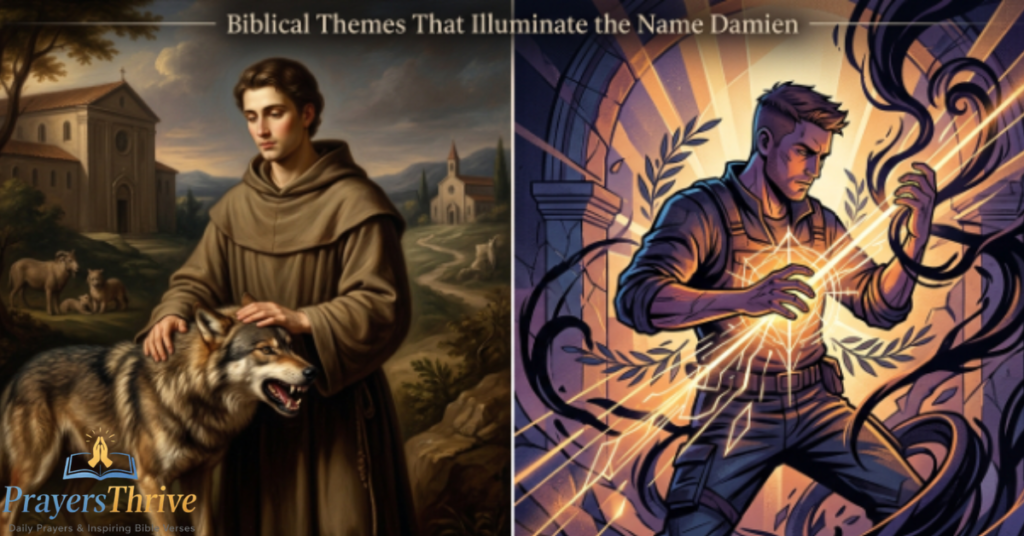
Biblical Themes That Illuminate the Name Damien
1. Self-Mastery as a Fruit of the Spirit
The deepest spiritual meaning embedded in the name Damien — the capacity to tame and master — finds direct biblical expression in one of the most significant passages in the New Testament.
“But the fruit of the Spirit is love, joy, peace, forbearance, kindness, goodness, faithfulness, gentleness and self-control. Against such things there is no law.”
— Galatians 5:22–23
The final fruit listed — self-control — translates the Greek word enkrateia, which shares the same conceptual root as damáō. It means the mastery of oneself from the inside out, produced not by willpower alone but by the transforming presence of God’s Spirit within a believer.
A name that literally means “one who masters” carries within it a living picture of what spiritual maturity looks like in a person genuinely surrendered to God.
“Better a patient person than a warrior, one with self-control than one who takes a city.”
— Proverbs 16:32
This proverb is striking in its boldness. Solomon — the wisest king in Israel’s history — places the person of inner self-mastery above the military conqueror. The one who can govern their own soul is greater than the one who can govern a city.
That is the spiritual weight carried by the name Damien.
2. The Overcomer: Conquering Through Christ
The Greek root damáō also carries the meaning of conquering and overcoming — and this theme runs through the New Testament with extraordinary force.
“In all these things we are more than conquerors through Him who loved us.”
— Romans 8:37
The Greek phrase translated “more than conquerors” is hypernikōmen — a compound word meaning to overwhelmingly, decisively, completely overcome. Paul is not describing a narrow victory. He is describing total, comprehensive triumph over every force that opposes the believer — suffering, hardship, danger, spiritual opposition.
A name rooted in the concept of conquering and subduing carries this same spiritual declaration over the person who bears it.
“For everyone born of God overcomes the world. This is the victory that has overcome the world, even our faith.”
— 1 John 5:4
The overcoming life is not accidental. It is the natural expression of genuine, living faith in the God who has already won.
see also: Owen Meaning in Bible: Explore Its Sacred Message
3. Taming the Tongue and the Inner Life
One of the Bible’s most vivid applications of the concept of taming appears in the letter of James — and it speaks directly to the spiritual challenge that defines the name Damien’s core meaning.
“People can tame all kinds of animals, birds, reptiles, and fish, but no one can tame the tongue. It is restless and evil, full of deadly poison.”
— James 3:7–8
James uses the language of taming — the same conceptual world as damáō — to describe the greatest challenge of human spiritual life. The tongue, the passions, the inner drives that pull a person toward destruction — these are the wild things that no human being can fully subdue through self-effort alone.
The implication is profound: what human strength cannot tame, divine transformation can.
A person named Damien carries a name that points toward this lifelong spiritual work — the ongoing, Spirit-empowered process of bringing the inner life into alignment with God’s character.
4. Spiritual Discipline and the Trained Life
“Train yourself for godliness; for while bodily training is of some value, godliness is of value in every way, as it holds promise for the present life and also for the life to come.”
— 1 Timothy 4:7–8
The Apostle Paul uses athletic training imagery — disciplined, deliberate, sustained effort — to describe the spiritual life. This is not passive religion. It is active, intentional cultivation of the inner person toward Christlikeness.
“No discipline seems pleasant at the time, but painful. Later on, however, it produces a harvest of righteousness and peace for those who have been trained by it.”
— Hebrews 12:11
Discipline is not punishment. In Scripture, it is the pathway to the most beautiful outcomes — righteousness, peace, spiritual fruitfulness. A name that means mastery and subduing speaks directly into this vision of the spiritually trained, disciplined life.
5. Strength in Service: Leadership and Responsibility
In Scripture, true strength is never self-serving. It is always oriented toward others — toward service, sacrifice, and the building up of community.
“Whoever wants to become great among you must be your servant, and whoever wants to be first must be your slave — just as the Son of Man did not come to be served, but to serve, and to give His life as a ransom for many.”
— Matthew 20:26–28
The strength symbolized by Damien — the mastery, the subduing, the conquering — finds its highest biblical expression not in domination but in sacrificial service. The person who has mastered themselves is the one most capable of genuinely serving others without ego, without bitterness, and without need for recognition.
The Hidden Christian Heritage of Damien: Saint Cosmas and Damian
Here is where the name Damien reveals a layer of spiritual significance that most people — even those who carry the name — never discover.
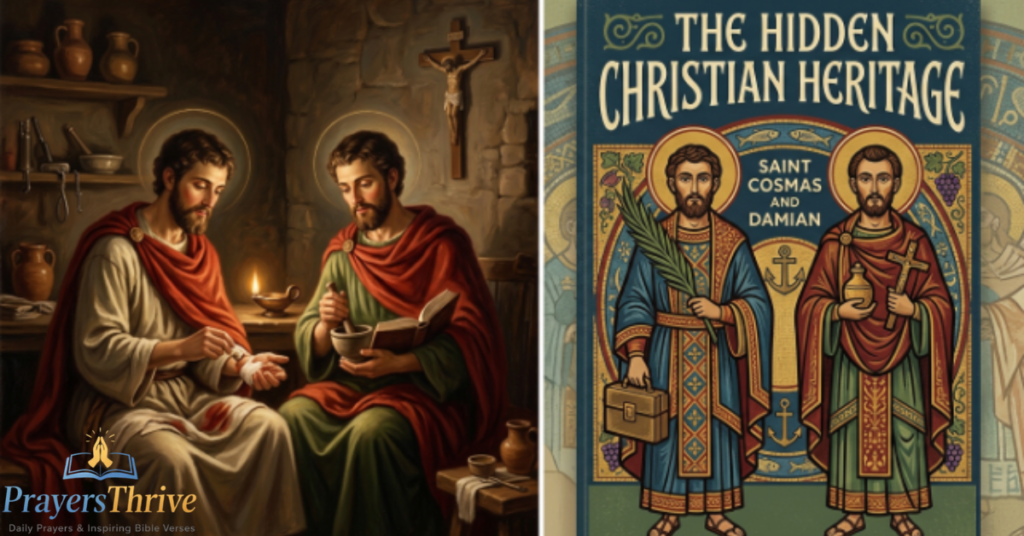
The name Damien is historically and inseparably linked to Saint Damian — one half of the twin saints Cosmas and Damian, who are among the most celebrated and beloved figures in early Christian history.
Who Were Cosmas and Damian?
Cosmas and Damian were twin brothers, believed to have been born in third-century Arabia, who became physicians of extraordinary skill and reputation. What set them apart from every other healer of their era was a single, defining practice — they charged absolutely nothing for their medical services.
History records them by a remarkable title: the Anargyroi — a Greek word meaning “the silverless ones” or “those who take no money.”
In an age when physicians served the wealthy and the powerful, Cosmas and Damian treated the poorest of the poor, the most marginalized of society, the people no one else would touch — and they did it freely, without charge, motivated entirely by their Christian faith and their love for God.
Their compassion was radical. Their sacrifice was total. Their testimony was irrefutable.
Their Martyrdom and Legacy
During the Diocletianic persecution — one of the most brutal campaigns against Christians in Roman history — Cosmas and Damian refused to renounce their faith despite extraordinary pressure and suffering. They were ultimately martyred for their allegiance to Christ.
Their courage under persecution, their lifelong commitment to serving the vulnerable, and their unwavering faithfulness to God made them revered figures throughout the early Church. Churches were dedicated to them across the Roman Empire. Their feast day — September 26 — is still observed in both Eastern and Western Christian traditions.
What This Means for the Name Damien
The historical Damian was not a figure of darkness or destruction. He was a physician of the poor. A servant of the marginalized. A martyr who chose death over denial of his Lord.
If your name is Damien, you carry — whether you knew it or not — the heritage of one of Christianity’s most selfless and courageous servants. That is a spiritual inheritance worth knowing.
The Spiritual Significance of Damien Across Scripture’s Biggest Themes

Transformation: From Wild to Purposeful
The concept of taming in Scripture is never about destruction — it is always about transformation. The wild horse is not killed; it is brought into purposeful partnership. The untamed energy is not eliminated; it is redirected toward something greater.
“Do not conform to the pattern of this world, but be transformed by the renewing of your mind. Then you will be able to test and approve what God’s will is — His good, pleasing and perfect will.”
— Romans 12:2
This is the spiritual journey embedded in the name Damien — the ongoing transformation of the natural person into someone whose energy, strength, and capacity are fully submitted to and directed by God.
Identity Rooted in Divine Purpose
Scripture consistently teaches that true identity is not found in cultural labels, family history, or personal achievement — it is found in relationship with God and alignment with His purposes.
“For we are God’s handiwork, created in Christ Jesus to do good works, which God prepared in advance for us to do.”
— Ephesians 2:10
The word translated “handiwork” is the Greek poiēma — from which the English word “poem” derives. Every person is a divine composition, crafted with intentionality and purpose. A name that speaks of mastery and overcoming is not accidental — it speaks into the kind of purposeful, disciplined life God designs for those who seek Him.
Endurance as Spiritual Victory
“I have fought the good fight, I have finished the race, I have kept the faith. Now there is in store for me the crown of righteousness.”
— 2 Timothy 4:7–8
Paul’s language here is the language of the overcomer — the one who subdued every obstacle, mastered every temptation, and ran every mile of the race set before him. The name Damien carries this same energy — not the arrogance of one who has never struggled, but the quiet, earned confidence of one who kept going when stopping would have been easier.
What the Name Damien Reveals About Spiritual Character
A name does not determine destiny. But it can declare an invitation — a spiritual posture, a set of values, a vision of the kind of person one is called to become.
The name Damien, understood fully, invites its bearer toward several defining spiritual qualities:
Inner mastery over impulse — choosing wisdom over reaction, discipline over indulgence, patience over frustration in every circumstance of daily life.
Courageous overcoming — facing the inevitable difficulties of life not with avoidance or despair but with the faith-rooted confidence that God has already secured the ultimate victory.
Strength expressed through service — using personal capacity, character, and gifting not for personal advancement but for the genuine blessing of others, following the pattern of Saint Damian and ultimately of Christ Himself.
Transformative resilience — allowing the difficult seasons of life to become the very instrument through which character is deepened, faith is strengthened, and spiritual maturity is forged.
FAQs
1. What is the true biblical meaning of the name Damien?
While the name Damien does not appear directly in biblical text, its meaning is deeply aligned with scriptural values. Derived from the Greek damáō, meaning to tame, subdue, and master, Damien spiritually represents self-control, overcoming through faith, inner transformation, and disciplined character — all of which Scripture celebrates as marks of genuine spiritual maturity. Combined with its historical connection to Saint Damian, the name carries a rich Christian heritage of sacrificial service and courageous faithfulness.
2. Is the name Damien associated with anything negative in the Bible?
No. The biblical and historical associations of the name Damien are entirely positive. Its Greek root speaks of mastery and overcoming — virtues Scripture praises. Its most prominent historical bearer, Saint Damian, was a Christian martyr and physician of the poor, celebrated across Christian traditions for his compassion and faithfulness. The negative cultural associations with the name come exclusively from twentieth-century popular entertainment, not from Scripture or Christian history.
3. What does the name Damien mean spiritually for someone who carries it?
Spiritually, carrying the name Damien is an invitation to embody its deepest meaning — to live as one who has brought the inner life under the Spirit’s mastery, who overcomes obstacles through faith rather than avoiding them, who serves others with the strength they have been given, and who endures difficulty with the quiet confidence of someone who knows how the story ends. It is a name that calls its bearer toward spiritual depth, disciplined faith, and sacrificial love.
4. How does the Saint Damian connection add meaning to the name?
Saint Damian was a third-century Christian physician who treated the poor without charge, lived with radical compassion, and ultimately gave his life rather than deny his faith. He represents the highest expression of what the name’s root meaning — strength and mastery — looks like when fully submitted to God: strength used entirely in service of others, mastery expressed as sacrifice rather than dominance. For anyone named Damien, Saint Damian offers a compelling historical and spiritual model of what a life lived fully in the name’s meaning can look like.
Conclusion
The name Damien has been misread by popular culture for generations. The truth, when you go back to the Greek roots, the scriptural alignment, and the Christian historical record, is far more compelling than the fiction.
Damien is a name that speaks of the person who has learned to master themselves — not through cold willpower, but through the transforming grace of a God who produces His own fruit in surrendered hearts.
It is a name that echoes the Apostle Paul’s declaration that believers are more than conquerors. That resonates with Solomon’s wisdom that self-mastery surpasses military conquest. That aligns with the Spirit’s own fruit of enkrateia — the divinely empowered capacity to govern the inner life with wisdom and grace.
And it is a name that carries the heritage of Saint Damian — a man who used every gift he possessed entirely in service of the most vulnerable, who faced death without flinching, and whose legacy of compassionate sacrifice the Church has honored for nearly two thousand years. If you carry the name Damien, carry it with the full weight of what it truly means. Not a curse. Not a shadow.
A calling — toward strength, toward service, toward the kind of overcoming life that only faith in the living God makes possible. “To the one who is victorious, I will give the right to sit with Me on My throne, just as I was victorious and sat down with My Father on His throne.”
— Revelation 3:21

I’m Aria, an AI content writing expert with 3 years of experience, creating engaging and inspiring faith-based content for readers seeking prayers, blessings, and Bible insights.