
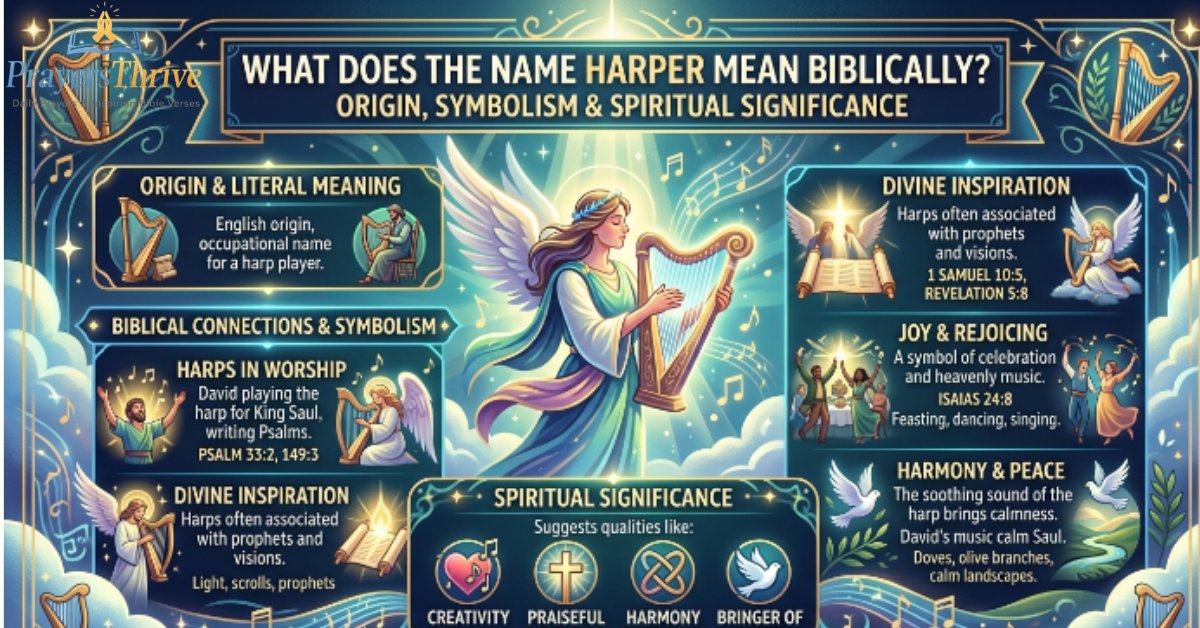
The name Harper has a warmth and artistry to it that feels both timeless and deeply intentional. In recent decades it has grown into one of the most beloved names for both boys and girls across the English-speaking world — but its roots stretch back far further than modern baby name trends. Beneath its elegant surface lies a meaning connected to one of the most spiritually significant instruments in all of Scripture: the harp.
While Harper does not appear by name in the Bible, its meaning places it in direct conversation with some of the most powerful themes in Scripture — worship, praise, the creative use of God-given gifts, and the kind of joyful devotion that transforms not just the person who expresses it, but everyone who hears it. For anyone exploring the biblical meaning of the name Harper, what follows is a thorough and genuinely illuminating look at where this name comes from, what it carries, and what it spiritually points toward.
see also: Pornography Prayer Points with Scriptures (Powerful & Effective Guide)
The Origin and Etymology of the Name Harper
Harper comes from Old English and Middle English roots, derived from the word hearpere, which referred to a person who played the harp — a skilled musician whose role in medieval society was both practical and elevated. It began as an occupational surname, given to families whose trade or art was the harp, and over centuries it transitioned into use as a first name, eventually becoming the widely loved given name it is today.
The harp itself is one of the oldest known musical instruments in human history. Archaeological evidence places early harp-like instruments in ancient Mesopotamia and Egypt dating back more than 5,000 years, and the instrument appears throughout the ancient Near East — including, prominently, in ancient Israel. Its strings, when skillfully played, produce a sound that has been described across cultures as uniquely capable of reaching the human soul — soothing, elevating, and stirring emotion in ways that other instruments cannot quite replicate.
This is precisely why the harp holds such a central place in the Bible, and why the name Harper carries such genuine spiritual weight when examined through a biblical lens.
The Harp in Scripture — Why It Matters for Understanding Harper
To understand the biblical significance of the name Harper, it is essential to understand how the harp functions in Scripture — because the instrument is far more than a musical detail. It is a recurring symbol of worship, intimacy with God, spiritual healing, and the expression of the deepest human emotions before the Creator.
The harp appears more than forty times across both the Old and New Testaments, and in nearly every instance it is connected to something spiritually significant.
King David is the figure most prominently associated with the harp in Scripture. Before he became Israel’s greatest king, David was brought to the court of King Saul specifically because of his skill with the harp — and because the music he played brought genuine spiritual relief. 1 Samuel 16:23 records that “whenever the spirit from God came on Saul, David would take up his lyre and play. Then relief would come to Saul; he would feel better, and the evil spirit would leave him.” This is a remarkable passage. It suggests that skilled, Spirit-directed musical worship had the power to create a spiritual environment — to invite God’s presence and drive out what opposed it.
David went on to become the primary author of the Psalms, and his relationship with the harp was inseparable from his relationship with God. The instrument was not merely a talent he possessed — it was the vehicle through which he expressed his deepest love, grief, faith, and gratitude before the Lord.
Psalm 33:2-3 commands: “Praise the Lord with the harp; make music to him on the ten-stringed lyre. Sing to him a new song; play skillfully, and shout for joy.” The call here is not casual — it asks for skill, intention, and joy together. It is worship that takes both the heart and the craft seriously.
Psalm 150:3 includes the harp among the full orchestra of praise: “Praise him with the sounding of the trumpet, praise him with the harp and lyre.” And in Revelation 5:8, the harp appears in the throne room of heaven itself, where the twenty-four elders hold golden harps as they worship the Lamb. The harp, in biblical cosmology, belongs to eternity. It is the instrument of heaven’s worship.
For a name whose core meaning is “harp player,” this biblical backdrop is extraordinary. Harper is not just a musician — in the biblical imagination, a harper is someone whose gift places them in the stream of worship that flows from earth all the way to the throne of God.
Biblical Themes Woven Into the Name Harper
Several distinct biblical themes emerge when the name Harper is examined through the lens of Scripture:
Worship as a Way of Life — The harp in Scripture is never merely entertainment. It is always connected to a posture of the heart — a turning toward God, an acknowledgment of His greatness, a response to His presence. The name Harper suggests a life oriented in this direction: one where creativity and skill are not ends in themselves, but offerings. A harper in the biblical tradition plays to Someone, not just for an audience.
The Healing Power of Spirit-Led Expression — David’s harp playing drove away the darkness that oppressed Saul. This suggests that genuine, Spirit-filled creative expression carries a spiritual dimension that goes beyond the natural. Those who bear the name Harper may find that their gifts — whether musical, artistic, verbal, or otherwise — have an unusual capacity to bring comfort, clarity, and peace to those around them.
Creativity as Calling — Scripture makes it clear from its earliest pages that human creativity reflects the image of God. Genesis 1 opens with God as Creator, and human beings made in His image are themselves creative by nature. The name Harper points to someone who takes this calling seriously — who understands that the gifts they carry are not accidents, but purposes, and who chooses to develop and offer those gifts with intention and devotion.
Joy and Praise — The harp in Scripture is consistently linked to joy. Psalm 81:2 says “Begin the music, strike the timbrel, play the melodious harp and lyre.” The word “melodious” suggests something that does not just function but flourishes — music that is genuinely beautiful. Harper as a name carries this association: a life that does not merely go through the motions of faith, but finds genuine delight in God and expresses it openly.
Harper and the Psalms — A Deep Spiritual Connection
The Book of Psalms is the Bible’s songbook, and it is impossible to read it without encountering the harp on nearly every page. The Psalms cover the full range of human experience — joy and grief, confidence and doubt, praise and lament — and in each emotional register, the harp is present. It is the instrument of the whole heart, not just the happy parts.
This gives the name Harper a richness that goes beyond simple musical association. A harper, in the tradition of the Psalms, is someone who brings their whole self to God — who does not edit their emotions for the sake of appearing more spiritual, but who learns to express everything, the joy and the sorrow alike, in the direction of God. Psalm 43:4 captures this beautifully: “Then I will go to the altar of God, to God, my joy and my delight. I will praise you with the lyre, O God, my God.” Even in a psalm that begins with distress, worship is the destination.
For someone named Harper, this Psalmic tradition offers a profound framework for life: a person whose creativity and expression are not separate from their faith but are the very language through which their faith is lived and communicated.
Hebrew Roots and Connections to Harper’s Meaning
The primary Hebrew word for harp used in the Old Testament is kinnor (כִּנּוֹר), the instrument most closely associated with David and the one most frequently mentioned in the Psalms. The kinnor was a lyre-type instrument with between seven and twelve strings, and it was considered the most prestigious of Israel’s instruments — the one reserved for worship, for royal courts, and for the expression of the highest form of human devotion.
The name Harper, meaning “one who plays the harp,” places its bearer in direct spiritual lineage with the kinnor tradition of ancient Israel — with David himself, with the Levitical musicians appointed to lead Israel’s worship, and with the heavenly worshippers of Revelation who hold golden harps before God’s throne.
This is not a trivial connection. In Israel, the appointment of musicians to lead worship was a serious and honored calling. 1 Chronicles 15:16 records that David ordered the Levite leaders to “appoint their fellow Levites as musicians to make a joyful sound with musical instruments: lyres, harps and cymbals.” Being a harper in ancient Israel was not a hobby — it was a vocation, a spiritual appointment, a calling that required both skill and consecration.
see also: 40 Powerful New Month Prayers and Blessings
Spiritual Character Qualities the Name Harper Reflects
When the full biblical picture of the harp and its players is brought to bear on the name Harper, several specific character qualities emerge:
Devotion — Every biblical harper plays in response to something — to God’s goodness, to His faithfulness, to the experience of being loved and rescued. The name Harper suggests a life marked by this same responsive devotion: a heart that notices God’s work and responds with gratitude and praise.
Sensitivity — The harp is a nuanced instrument, responsive to the slightest variation in touch. Harpers in Scripture often seem to carry this same quality of spirit — a sensitivity to God’s presence, to the needs of others, and to the spiritual dimensions of situations that others might miss. This sensitivity, when submitted to God, becomes a gift.
Perseverance in Craft — Psalm 33 calls for skilled playing — not just enthusiastic playing, but skillful playing. This implies practice, dedication, and the willingness to develop a gift over time rather than leaving it undeveloped. The name Harper carries an implicit invitation to take one’s gifts seriously and invest in them for God’s purposes.
Encouragement and Uplift — David’s harp playing lifted Saul out of darkness. This dimension of Harper’s meaning points toward someone whose presence and expression genuinely helps others — who brings light into heavy situations and whose creative gifts are a source of comfort and strength.
Encouragement for Anyone Named Harper
If your name is Harper, you carry something meaningful in its syllables — a connection to one of the most spiritually significant roles in all of Scripture. The biblical harp player was not a peripheral figure. They were the one who set the atmosphere for worship, who soothed troubled hearts, who led God’s people into His presence through the faithful and skillful use of a God-given gift.
Ephesians 2:10 says: “For we are God’s handiwork, created in Christ Jesus to do good works, which God prepared in advance for us to do.” The word translated “handiwork” is the Greek poiema — from which we get the English word “poem.” You are God’s creative work, made with intention and purpose. The gifts you carry — whatever form they take — are part of that intentional design.
The name Harper is an invitation to live that out: to take your gifts seriously, to offer them generously, to use them in ways that honor God and encourage the people around you. It is a name that says, in its quiet way, this person was made to bring something beautiful into the world.
FAQs
1. Is Harper a Christian or biblical name?
Harper isn’t directly in the Bible, but its meaning “harp player” connects deeply to Scripture’s themes of worship, praise, and God’s presence.
2. What is the spiritual significance of the harp in the Bible?
The harp appears 40+ times in Scripture, symbolizing worship, spiritual healing, and divine presence — from David’s courts to heaven’s throne room in Revelation.
3. What biblical character best represents the spirit of the name Harper?
King David — a devoted harpist whose music drove away darkness and whose Psalms became the foundation of Israel’s entire worship tradition.
4. How can someone named Harper live out the spiritual meaning of their name?
By developing their God-given gifts with skill and sincerity, then offering them generously to encourage others and honor God.
Conclusion
The biblical meaning of the name Harper is richer and more layered than its simple definition of “harp player” might first suggest. Traced through Scripture, the harp is an instrument of worship, healing, praise, and heavenly devotion — present from the courts of ancient Israel all the way to the throne room of eternity described in Revelation. A name rooted in this instrument carries all of that weight and beauty with it.
Harper is a name for someone called to creative devotion — someone whose gifts, whatever they are, are meant to be offered rather than hidden, developed rather than neglected, and directed toward God and the good of others rather than kept as a private possession. It is a name that points toward a life of worship in the broadest and most biblical sense: a life where creativity, faith, joy, and service come together in something genuinely beautiful.
For anyone who bears this name, Scripture’s portrait of the harp and its players is not just historical background — it is a personal invitation. Play skillfully. Play wholeheartedly. Let what you create bring light, comfort, and the quiet reminder that God is worthy of every gift we have to offer.

I’m Aria, an AI content writing expert with 3 years of experience, creating engaging and inspiring faith-based content for readers seeking prayers, blessings, and Bible insights.