
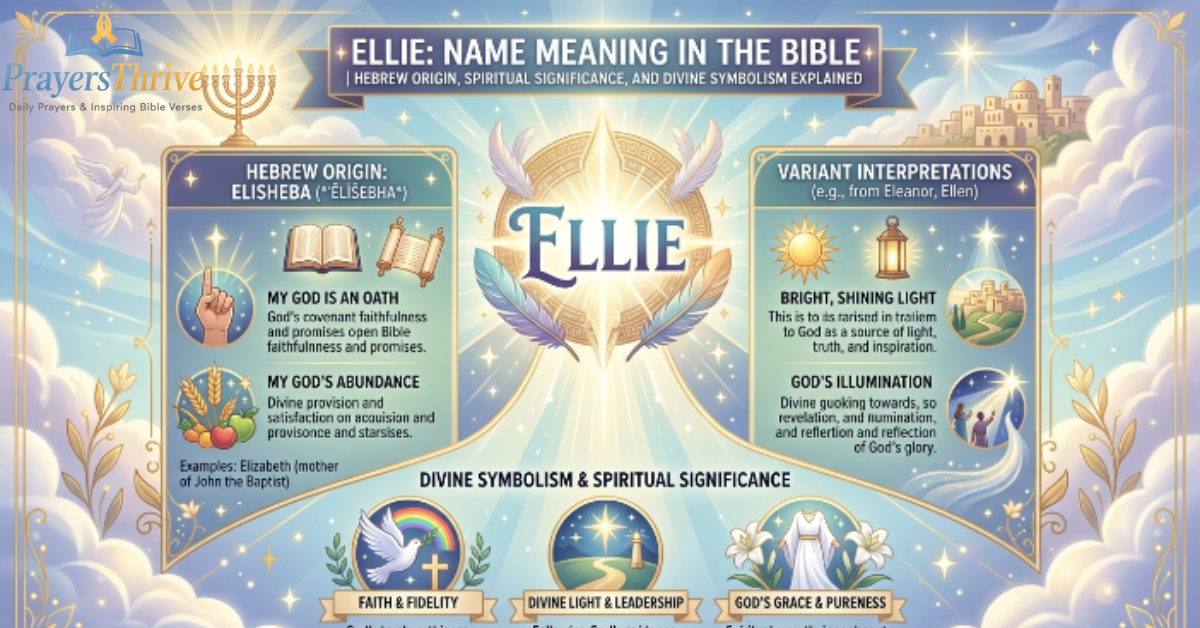
Some names feel gentle on the surface but carry extraordinary weight beneath it.Ellie is exactly that kind of name. To the casual observer, it sounds light, modern, and warmly familiar — a name that feels equally at home in a nursery and in a grandmother’s memory. But the moment you trace its roots back through history, through language, through the ancient Hebrew foundations from which it grows — everything changes.
Because at the very core of the name Ellie sits one of the most theologically significant words in all of human language.
El.
Two letters. One syllable. And yet — the Hebrew name for the living God Himself.
Every name that begins with El — and Ellie is among them — carries within it a direct linguistic connection to the Creator of the universe, the covenant-keeping God of Abraham, Isaac, and Jacob, the God whose nature and character fill every page of Scripture from beginning to end. That is not a small thing.
Whether you are a parent praying over a name for your daughter, someone named Ellie seeking a deeper understanding of your own spiritual identity, or simply someone captivated by the profound significance Scripture attaches to names — this guide will take you further than any surface-level article can.
Because the name Ellie is not just beautiful. It is biblically rooted, spiritually rich, and divinely significant in ways that most people who carry it have never fully understood.
see also: 60+ Pornography Prayer Points for Freedom and Healing
Is the Name Ellie Found Directly in the Bible?
This is always the first question — and it deserves a clear, complete answer before anything else. The name Ellie, in its modern shortened form, does not appear verbatim anywhere in the canonical text of the Hebrew Old Testament or the Greek New Testament. But this answer, taken alone, tells less than half the story.
The name Ellie is not an invented modern word with no history. It is a diminutive — an affectionate, shortened form — of multiple deeply biblical names, all of which are rooted in the same ancient Hebrew foundation and all of which appear prominently throughout Scripture. Understanding Ellie biblically requires understanding where it comes from — and the roots are extraordinary.
The Hebrew Foundation: El — The Name Above All Names
To understand the name Ellie at its deepest level, you must begin with the Hebrew word at its core.
El (אֵל) is one of the oldest and most theologically significant words in the entire Hebrew language. It is the primary Hebrew word for God — not a description of God, not a metaphor for God, but the actual name used throughout the Old Testament to identify the living, eternal, all-powerful Creator of all things.
El appears hundreds of times throughout the Hebrew Scriptures — sometimes alone, sometimes combined with other Hebrew words to form the compound divine names that reveal specific aspects of God’s character and nature.
The Compound Names of El in Scripture
Each of these divine compound names contains the same El root that sits at the foundation of the name Ellie:
El Shaddai — God Almighty, the All-Sufficient One
“When Abram was ninety-nine years old, the Lord appeared to him and said, ‘I am God Almighty; walk before Me faithfully and be blameless.'”
— Genesis 17:1
El Elyon — God Most High, supreme above all powers and kingdoms
“Blessed be Abram by God Most High, Creator of heaven and earth.”
— Genesis 14:19
El Roi — The God Who Sees, the One who observes and responds to human suffering
“She gave this name to the Lord who spoke to her: ‘You are the God who sees me.'”
— Genesis 16:13
El Olam — The Everlasting God, whose existence has no beginning and no end
“Abraham planted a tamarisk tree in Beersheba, and there he called on the name of the Lord, the Everlasting God.”
— Genesis 21:33
El Gibbor — The Mighty God, the warrior God whose strength is without limit
“For to us a child is born… And He will be called Wonderful Counselor, Mighty God, Everlasting Father, Prince of Peace.”
— Isaiah 9:6
Every single one of these names — El Shaddai, El Elyon, El Roi, El Olam, El Gibbor — begins with the exact same Hebrew root that forms the foundation of the name Ellie.
When someone bears the name Ellie, they carry within their very name a linguistic echo of every one of these divine titles. Not by accident. Not by coincidence. But because names rooted in El have always, in the biblical tradition, pointed directly toward nature, character, and the presence of God Himself.
The Biblical Names from Which Ellie Descends
The name Ellie functions as a diminutive form of several prominent biblical names — each of which is deeply rooted in Scripture and carries its own rich theological significance.
Elizabeth — “My God Is an Oath” or “My God Is Abundance”
The name Elizabeth comes from the Hebrew Elisheba — a compound of El (God) and sheva (oath, or seven — the number of completeness and covenant in Hebrew thought).
Together, Elizabeth means “My God is my oath” or “My God is fullness” — a declaration that God Himself is the ultimate covenant-keeper, the One whose promises are absolutely certain and completely trustworthy.
Elizabeth appears in the New Testament as one of the most spiritually significant women in the entire Gospel narrative. She was the mother of John the Baptist — the forerunner of Jesus Christ — and the woman whose Spirit-filled greeting confirmed Mary’s identity as the mother of the Messiah.
“When Elizabeth heard Mary’s greeting, the baby leaped in her womb, and Elizabeth was filled with the Holy Spirit.”
— Luke 1:41
Elizabeth’s life embodied everything her name declared — she waited faithfully through decades of barrenness, trusted God’s covenant promises when human hope had expired, and ultimately became the mother of the prophet who prepared the way for the Son of God.
Every Ellie who descends from this name inherits a spiritual heritage of covenant faithfulness, Holy Spirit sensitivity, and the kind of enduring trust in God’s promises that does not waver even through the longest seasons of waiting.
Elijah — “My God Is Yahweh”
The name Elijah comes from the Hebrew Eliyahu — a compound of El (God) and Yahu (a shortened form of Yahweh, the covenant name of God) — meaning “My God is Yahweh” or “Yahweh is my God.”
This name is not a passive religious statement. It is a bold, public, confrontational declaration — spoken in a cultural context where the worship of Baal and other false gods was aggressively promoted by the ruling powers of Israel.
Elijah was the prophet who stood alone on Mount Carmel against 450 prophets of Baal, called down fire from heaven, and demonstrated before the entire nation of Israel that Yahweh alone is the living God.
“Answer me, Lord, answer me, so these people will know that You, Lord, are God, and that You are turning their hearts back again.”
— 1 Kings 18:37
Elijah also fled in exhaustion and despair after his greatest victory — and God met him not in the dramatic fire or the powerful wind, but in a gentle whisper. He experienced the full range of prophetic ministry — mountain-top triumph and valley-floor exhaustion — and God sustained him through both.
“The angel touched him and said, ‘Get up and eat, for the journey is too much for you.'”
— 1 Kings 19:7
Every Ellie who descends from the name Elijah carries a spiritual heritage of bold, uncompromising declaration of God’s supremacy, courageous faith in the face of overwhelming opposition, and the tender truth that God meets His servants even in their moments of deepest vulnerability.
Eleanor — “God Is My Light” or “Shining One”
The name Eleanor traces through Old French and Provençal roots back to a meaning most commonly rendered as “God is my light” or “the bright, shining one” — connecting directly to the biblical theme of divine illumination and radiant witness.
This meaning finds deep resonance throughout Scripture’s consistent use of light as the defining metaphor for God’s presence, truth, and guiding wisdom.
Ellen — “Bright, Shining Light”
The name Ellen derives from the Greek Helene, meaning bright, torch, or shining light — a name that carries the same luminous symbolism as Eleanor and connects Ellie to the biblical imagery of light bearing, witness, and divine illumination that Jesus Himself calls His followers to embody.
What Scripture Reveals Through the Spiritual Themes of Ellie
1. God’s Covenant Faithfulness — The Elizabeth Legacy
The deepest spiritual theme carried by the Elizabeth branch of Ellie’s heritage is covenant faithfulness — the absolute, unbreakable reliability of God’s promises even when human circumstances suggest those promises have been forgotten.
Elizabeth waited more than a lifetime by human reckoning. She and her husband Zechariah were described as righteous before God, walking blamelessly in all His commandments — and yet they remained childless into old age. Every human indicator said the promise was not coming. And then it did.
“But the angel said to him: ‘Do not be afraid, Zechariah; your prayer has been heard. Your wife Elizabeth will bear you a son, and you are to call him John. He will be a joy and delight to you, and many will rejoice because of his birth.'”
— Luke 1:13–14
The spiritual significance of this for everyone who carries the name Ellie is profound. A name connected to Elizabeth carries the declaration that God’s covenants do not expire. His promises do not have a use-by date. His faithfulness does not diminish with the passing of years or the accumulation of disappointments.
“Know therefore that the Lord your God is God; He is the faithful God, keeping His covenant of love to a thousand generations of those who love Him and keep His commandments.”
— Deuteronomy 7:9
2. Bold Declaration of God’s Supremacy — The Elijah Legacy
The Elijah branch of Ellie’s heritage carries an equally powerful but strikingly different spiritual theme — the courageous, uncompromising declaration that God alone is supreme, that no false god or cultural pressure has any legitimate claim over a life surrendered to Yahweh.
“How long will you waver between two opinions? If the Lord is God, follow Him; but if Baal is God, follow him.”
— 1 Kings 18:21
Elijah’s question on Mount Carmel is one of the most spiritually clarifying questions in all of Scripture. It cuts through every form of spiritual ambiguity and compromise and demands a clear, decisive answer — who is your God?
A name connected to Elijah carries this same clarifying energy — the spiritual invitation to make the same bold declaration that gives the name its meaning: My God is Yahweh. Not partially. Not conveniently. Not only when it is culturally comfortable. Completely, publicly, and without apology.
“If God is for us, who can be against us?”
— Romans 8:31
see also: Biblical Meaning of 32: Spiritual Significance & Symbolism Explained
3. Divine Light and Illumination — The Eleanor and Ellen Legacy
Through its Eleanor and Ellen branches, the name Ellie carries the powerful biblical theme of divine light — God’s illuminating presence that guides, reveals, protects, and transforms.
“Your word is a lamp for my feet, a light on my path.”
— Psalm 119:105
Light in Scripture is never merely decorative. It is always functional — it reveals what darkness hides, it guides where confusion disorients, it protects where danger lurks unseen. God’s light is the most practical of all divine gifts because it makes every other gift accessible.
“The Lord is my light and my salvation — whom shall I fear? The Lord is the stronghold of my life — of whom shall I be afraid?”
— Psalm 27:1
David’s declaration connects light directly to salvation and fearlessness — a trio of spiritual realities that flow from the same divine source. A name associated with light carries within it this same connected promise — that God’s illuminating presence is simultaneously His saving presence and His protecting presence.
Jesus declared Himself the fulfillment of everything light represents in the Old Testament:
“I am the light of the world. Whoever follows Me will never walk in darkness, but will have the light of life.”
— John 8:12 And then He turned to His followers and declared the same identity over them:
“You are the light of the world.”
— Matthew 5:14
A name rooted in the meaning of light carries this extraordinary declaration — not as arrogance but as identity. The one who follows Jesus inherits His light-bearing nature and is called to radiate it into every dark corner they encounter.
4. Humility Before God — The El Foundation
Every name built on the Hebrew El foundation carries within it an implicit theological statement about the relationship between the human and the divine. To say “El is my God” — in any of its forms — is to position oneself in humble, dependent relationship to the supreme Being rather than in autonomous self-sufficiency.
“He has shown you, O mortal, what is good. And what does the Lord require of you? To act justly and to love mercy and to walk humbly with your God.”
— Micah 6:8
Walking humbly with God is not a passive posture. It is an active, daily, deliberate choice to orient every decision, every relationship, and every aspiration in reference to the God whose name you carry.
The name Ellie — rooted in El — is at its spiritual core a name of humble, dependent, confident relationship with the living God. Not self-made strength but God-given strength. Not self-generated light but God-reflected light. Not self-produced joy but Spirit-filled joy.
“Humble yourselves before the Lord, and He will lift you up.”
— James 4:10
5. Prophetic Sensitivity and Holy Spirit Awareness
Through the Elizabeth connection — the woman who was filled with the Holy Spirit and recognized the presence of Jesus before He had spoken a single word — the name Ellie carries a spiritual theme of prophetic sensitivity, Spirit-led discernment, and the kind of inner awareness that recognizes God’s movement before it becomes publicly obvious.
“Blessed is she who has believed that the Lord would fulfill His promises to her.”
— Luke 1:45
These are the words Elizabeth spoke to Mary — a declaration of blessing over faith that believes before it sees, that trusts the promise before the evidence arrives.
A name connected to Elizabeth carries the spiritual invitation to this same quality of believing faith — the faith that takes God at His word and declares His promises fulfilled before the circumstances have caught up with the covenant.
6. Enduring Joy Rooted in God’s Presence
“You make known to me the path of life; in Your presence there is fullness of joy; at Your right hand are pleasures forevermore.”
— Psalm 16:11
The name Ellie carries a natural warmth and lightness that resonates with this Psalm — the declaration that genuine, lasting, unshakeable joy is found specifically and exclusively in the presence of God.
This is not the fragile happiness that depends on favorable circumstances, comfortable relationships, and manageable challenges. This is the deep, anchored, Spirit-rooted joy that Paul describes from inside a prison cell:
“Rejoice in the Lord always. I will say it again: Rejoice!”
— Philippians 4:4
The instruction to rejoice always is only possible if the source of that joy is located somewhere circumstances cannot reach. A name rooted in El — in the presence and nature of God Himself — carries the promise of exactly this kind of joy.
The Name Ellie and the Biblical Pattern of God Working Through the Humble
One of the most consistent and beautiful patterns running through the entire biblical narrative is God’s deliberate choice to work powerfully through people the world overlooks, underestimates, or considers insignificant.
Elizabeth — dismissed by her culture as barren and therefore, in that worldview, somehow spiritually deficient — became the mother of the greatest prophet born of woman.
Elijah — a solitary, socially isolated prophet standing alone against the entire religious and political establishment of his nation — became the instrument through which God demonstrated His supreme power before the whole of Israel.
The name Ellie carries this same pattern as part of its spiritual DNA — the declaration that God does not require human greatness, cultural prominence, or impressive credentials to accomplish His most significant purposes. He requires only a willing, humble, faithful heart.
“But God chose the foolish things of the world to shame the wise; God chose the weak things of the world to shame the strong.”
— 1 Corinthians 1:27
FAQs
1. What is the true biblical meaning of the name Ellie?
The name Ellie carries deep biblical meaning through its roots in the Hebrew word El — the primary name for God in the Old Testament — and its descent from multiple biblical names including Elizabeth and Elijah. Through Elizabeth, it means “My God is covenant” — carrying themes of faithful waiting, Holy Spirit sensitivity, and God’s unbreakable promises. Through Elijah, it means “My God is Yahweh” — carrying themes of bold faith, courageous declaration of God’s supremacy, and divine sustaining in moments of exhaustion. Through Eleanor and Ellen, it carries the meaning of divine light — God’s illuminating, guiding, protecting presence. Together, the name Ellie declares a life rooted in the presence, faithfulness, and light of the living God.
2. Is Ellie a biblical name suitable for a Christian baby girl?
Yes — Ellie is a deeply meaningful choice for Christian parents seeking a name with genuine biblical roots and spiritual depth. Its direct connection to the Hebrew El — the name of God — gives it an immediate theological foundation that few modern names can match. Its heritage through Elizabeth and Elijah connects it to two of the most spiritually significant figures in the New and Old Testaments respectively. The name declares over a child’s life themes of covenant faithfulness, courageous faith, divine illumination, humble dependence on God, and the enduring joy that flows from His presence.
3. What is the connection between Ellie and the Hebrew name for God?
The connection is direct and linguistically foundational. The Hebrew word El is the primary divine name used throughout the Old Testament to refer to the living God. It appears alone as a name for God and in combination with other Hebrew words to form the compound divine names — El Shaddai, El Elyon, El Roi, El Olam, El Gibbor — that reveal specific aspects of God’s nature and character. The name Ellie, as a diminutive of names like Elizabeth and Elijah, begins with this same El root. Every time the name Ellie is spoken, it carries the linguistic echo of the Hebrew name of God within it — making it, in the deepest sense, a name that points directly toward the divine.
4. What Scripture verses best reflect the spiritual meaning of the name Ellie?
Several passages align with exceptional depth to the spiritual themes the name carries. Luke 1:41–45 captures the Elizabeth heritage — Holy Spirit filling, prophetic recognition, and the blessing of believing faith. First Kings 18:37–39 captures the Elijah heritage — the bold declaration of God’s supremacy and the fire of divine confirmation. Psalm 27:1 captures the light heritage — “The Lord is my light and my salvation.” Philippians 4:4 captures the joy heritage — rejoicing always because the source of joy is located in God rather than in circumstances. And Deuteronomy 7:9 captures the covenant heritage — the faithful God who keeps His covenant promises to a thousand generations.
Conclusion
The name Ellie has been present in the world for centuries — carried across generations in its various forms, spoken with affection in countless languages and cultures, borne by women of extraordinary faith and ordinary faithfulness alike.
But most people who give this name — or receive it — have never fully grasped what it truly carries within it.At its very core, the name Ellie contains the Hebrew name of God Himself.
It carries Elizabeth’s legacy — the woman who waited faithfully through every humanly hopeless season and discovered that God’s covenant promises have no expiration date. It carries Elijah’s legacy — the prophet who stood alone on a mountain and declared without flinching that Yahweh alone is God, and who discovered in the gentle whisper that God’s tenderness is as real as His power. It carries the light of Eleanor and Ellen — the divine illumination that guides every step, reveals every hidden truth, and transforms darkness into clarity wherever it shines.
And it carries the deep, settled, unshakeable joy of a life lived in the presence of El — the God whose name you carry, whose covenant you have inherited, whose light you are called to reflect. If your name is Ellie — carry it with the full understanding of what it means. Not just a modern name. Not just a gentle sound. A declaration — that God is your covenant, your Yahweh, your light, and the source of every joy that endures.
“The Lord your God is with you, the Mighty Warrior who saves. He will take great delight in you; in His love He will no longer rebuke you, but will rejoice over you with singing.”
— Zephaniah 3:17
The God whose name you carry rejoices over you. That is what it means to be Ellie.

I’m Aria, an AI content writing expert with 3 years of experience, creating engaging and inspiring faith-based content for readers seeking prayers, blessings, and Bible insights.